
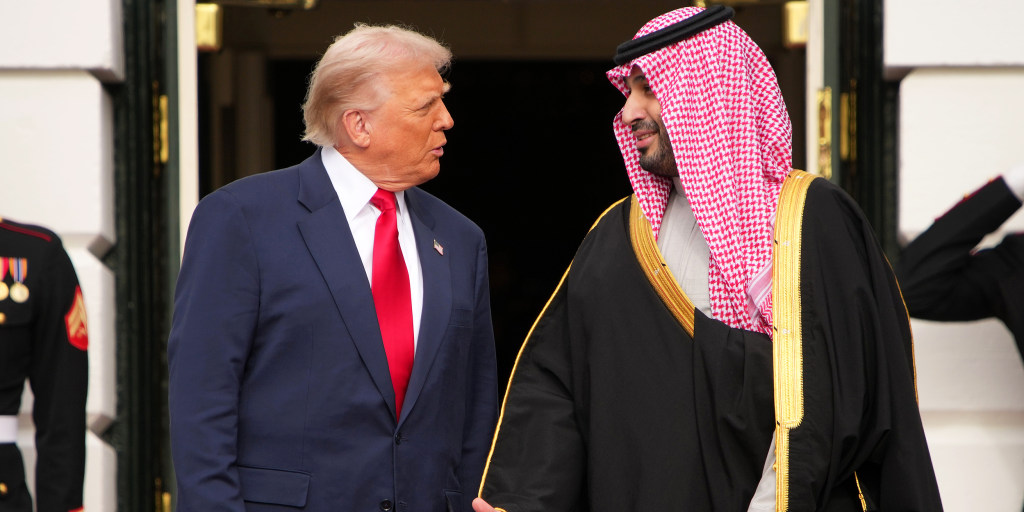
President Donald Trump approved a landmark civilian nuclear deal with Saudi Arabia, and the Trump administration signed a nuclear cooperation agreement on Wednesday.
The Department of Energy said Energy Secretary Chris Wright and Saudi Energy Minister Prince Abdulaziz bin Salman signed the cooperation agreement and an accompanying safeguards agreement, the agency announced Wednesday.
The cooperation pact gives American companies priority access to the Saudi nuclear energy program, allowing U.S. firms to run commercial nuclear power plants on Saudi soil and to supply reactors and fuel; the Energy Department said the deal is expected to last decades and be worth billions of dollars, and officials have described the framework as spanning 30 years and valued at tens of billions.
An administration memo said the agreement does not include provisions known as the "gold standard" that would prohibit the kingdom from enriching uranium or reprocessing nuclear fuel, and it does not require Saudi Arabia to adopt terms that would lead to greater oversight from the International Atomic Energy Agency; the memo said the United States does not support a Saudi nuclear weapons program and that the pact includes nonproliferation terms under the Atomic Energy Act.
The memo says the pact provides a legal pathway for cooperation on the nuclear fuel cycle but does not obligate the United States to transfer any fuel cycle capabilities or technologies to Saudi Arabia.
Energy Secretary Chris Wright said, "These agreements reflect our two nations' shared commitment to strengthening U.S.-Saudi commercial relations, delivering prosperity at home and security to our allies abroad. Rest assured, these agreements uphold the highest standards of nuclear safety and nonproliferation, while relying on the world's best nuclear technology and scientists, designed right here in the United States."
Critics and experts raised proliferation concerns: Darya Dolzikova said, "Any country, period, but particularly countries of proliferation concern have to be really, really robust on their nonproliferation provisions," and Sanam Vakil said, "If Saudi Arabia does retain the right to enrich, it’s the issue of domestic enrichment that will be more concerning and alarming." Matthew Bunn said the agreement "may make negotiating a reasonable deal with Iran more difficult." Rep. Brad Sherman, D-Calif., said Congress should approve only if the deal has the same gold-standard safeguards as the UAE and added, "A President waging war to prevent nuclear proliferation in the Middle East should not facilitate proliferation just because U.S. companies stand to make a profit."
The administration is expected to submit the agreement to Congress as required by federal law; Congress must review the deal and has 90 days to consider it, and lawmakers would need a veto-proof majority to block it.
Observers placed the pact in a broader regional context, saying the civilian deal is likely to irritate Iran, that the United States and Israel launched a war against Iran in late February that continues, that Saudi Arabia signed a mutual defense pact with Pakistan whose defense minister said Pakistan’s nuclear program would "be made available" to Saudi Arabia if required, and that Gulf tensions have included a rift between Saudi Arabia and the United Arab Emirates.
An administration memo said the agreement specifically forbids reprocessing American-supplied nuclear material for weapons, while still lacking the full "gold standard" language that would bar Saudi enrichment or reprocessing of other nuclear material.
President Trump did not preside over the signing ceremony; he attended a dignified transfer ceremony for four U.S. service members killed in Iran and later held a campaign rally in Georgia.
The agreement reverses a yearslong U.S. stance that had tied provision of American civilian nuclear technology to Saudi normalization of relations with Israel, a shift observers said reflects the administration's transactional approach to regional diplomacy.
The pact also differs from a 2009 U.S. agreement with the United Arab Emirates, which included strict inspections by the International Atomic Energy Agency; the Saudi deal reportedly allows Saudi Arabia to enrich uranium on its own soil.
Reactions included warnings that a civilian program could spur a regional arms race: Avigdor Lieberman, a member of the Israeli parliament and a former defense minister, said a civilian nuclear program in Saudi Arabia could "lead to a mad arms race across the entire Middle East," and Rep. Ro Khanna, D-Calif., said, "The deal really is a giveaway to the Saudis, and it's only going to fuel further ambitions from Iran. It's only going to further destabilise the region with Israel."
On Thursday, President Trump wrote on Truth Social that "the Civil Nuclear Deal (There will be no enrichment of material!) being made between the United States Department of Energy and Saudi Arabia... will be approved, but is totally subject to Saudi Arabia joining the very respected and successful Abraham Accords," saying the deal "pertains only to non-military use."
White House press secretary Karoline Leavitt said during a press briefing that any nuclear deal with Saudi Arabia would be contingent on the kingdom joining the Abraham Accords, echoing the president's Truth Social post.
The Energy Department's announcement Wednesday did not mention the Abraham Accords, and Saudi Arabia's own release about the agreement made no mention of Trump's stipulations, saying the deal would attempt to "diversify energy sources, advance cutting-edge technologies, and expand opportunities for cooperation and investment in ways that serve the mutual interests of the two friendly countries."
Reporting indicates the agreement includes a joint U.S.–Saudi study on possible future uranium enrichment and could allow U.S. companies to build a uranium enrichment facility in Saudi Arabia pending that study; three people familiar with the agreement said it was not expected to require the most rigorous level of U.N. inspections or to include a ban on uranium enrichment or reprocessing of spent fuel.
The Saudis have said they will not normalize relations with Israel without progress toward a Palestinian state, and some analysts and lawmakers have warned that the deal could further proliferative risks in the region even as administration officials argue it advances nonproliferation goals and economic ties.