
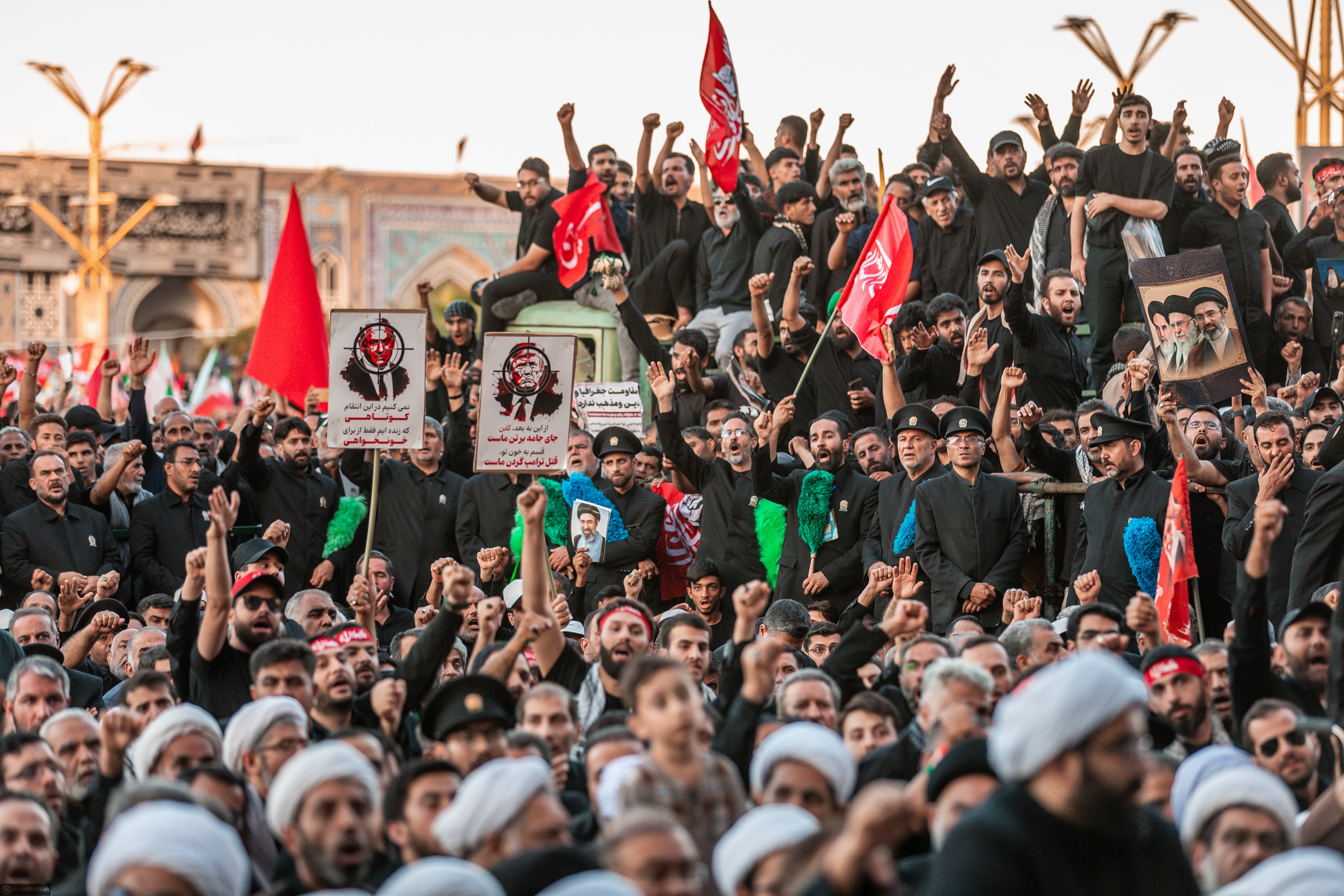
President Donald Trump threatened Iran in the early hours of Saturday, saying he would "decimate and destroy" the country if Tehran acted on threats to assassinate him after the funeral of Supreme Leader Ayatollah Ali Khamenei included chants calling for his killing.
Trump wrote on his Truth Social account, "1000 Missiles are Locked and Loaded and aimed at the Islamic Republic of Iran, with thousands of more to immediately follow, should the Iranian Government act on its threat, pronounced in many corners of the Globe, to assassinate, or attempt to assassinate, the sitting President of the United States of America, in this case, ME!" He added, "Orders have already been given, and the U.S. Military is ready, willing, and able, for a one year period of time, subject to extension, to completely decimate and destroy all areas of Iran - PRAISE BE TO ALLAH!"
The U.S. Secret Service recommended that Trump travel aboard the older Air Force One rather than the newly retrofitted Boeing 747 donated by Qatar as a security precaution, and White House Communications Director Steven Cheung said the new Air Force One is equipped with advanced security features. On his way back from Turkey, Trump traveled in the old Air Force One plane rather than the new plane the U.S. received from Qatar; security concerns prompted a mid-trip switch in planes. He also told the New York Post he had left standing instructions to strike Iran if an assassination attempt succeeded.
On Wednesday, Trump told reporters that Iran was plotting to assassinate him, saying, "They want to take out the U.S. leader — me. I'm on every list. I saw this morning, I'm on every single one of their lists. And so far, I guess I've been a little bit lucky, but that maybe doesn't last very long."
Trump received intelligence briefings from Israeli authorities that the Iranian regime was targeting him for assassination, U.S. and Israeli officials said, and U.S. and Israeli officials warned U.S. counterparts earlier in the week about an alleged Iranian plot. Trump said he had already directed the U.S. military to be prepared to retaliate if Iran carried out an assassination attempt.
Khamenei was killed by an airstrike on Feb. 28, and Iran buried him this week after a dayslong funeral ceremony that took his body to cities in both Iran and Iraq; Iran has said its theocracy is unified under a new supreme leader, Mojtaba Khamenei.
Supreme Leader Mojtaba Khamenei announced on Saturday that revenge for his father's assassination "will most certainly be carried out." Mojtaba Khamenei, who was seriously wounded in the attack that killed his father and has not appeared in public since, pledged on his Telegram channel to "avenge your pure blood and the blood of all those martyred in these two wars by bringing the criminal and dishonorable killers to justice." He wrote that "this revenge is the demand of our nation, and it will most certainly be carried out," and added that whether he is alive or dead "the revenge for his father's death will be accomplished," saying "soon, freedom-loving people throughout the world will each carry out part of this divine mission." He did not specifically mention Trump in the post.
Senior U.S. officials had demanded that Iran publicly say the Strait of Hormuz is open, but Tehran has not done so and instead insists the route remain under its control and that it be allowed to charge ships moving through it. Tehran's diplomat at the United Nations told reporters that any activity in the Strait of Hormuz, including its opening or demining operations, "rests exclusively with Iran." About a fifth of all traded oil and natural gas passed through the strait before the war, and the U.S. continues to urge mariners to travel on a southern route through Oman's territorial waters to avoid Iranian waters and commands from its paramilitary Revolutionary Guard.
There have been multiple days of U.S. airstrikes targeting Iranian sites and Iranian retaliatory fire across the Mideast after Iran attacked three ships earlier this week, U.S. officials said. U.S. officials said the resumption of strikes came after what they described as a rogue faction of Iranian hard-liners trying to sabotage the ceasefire.
Following Iranian resumption of attacks on international shipping in the Strait of Hormuz, the U.S. Treasury Department's Office of Foreign Assets Control took action against alleged financier Ali Ansari, who the department said oversees a sprawling global network of assets benefitting Iran's leader, Mojtaba Khamenei, and the department withdrew a waiver that had allowed Iran to sell oil. Treasury Secretary Scott Bessent said, "The so-called Supreme Leader is hiding in seclusion while his regime crumbles. Treasury will continue using every tool at its disposal to isolate him and other regime elites from the global financial system. We will preserve these assets for the Iranian people." Iranian Foreign Minister Abbas Araghchi said the move violated the June memorandum of understanding between the U.S. and Iran, and Tasnim news agency reported Araghchi arrived in Oman early Saturday for talks.
Pakistan's Prime Minister Shehbaz Sharif held a phone call with Iranian President Masoud Pezeshkian to express "deep concern" and urged both Iran and the U.S. to exercise restraint, and Turkish Foreign Minister Hakan Fidan said he believed "a solution can be reached" this weekend. Iran's parliamentary speaker and lead negotiator, Mohammad Bagher Ghalibaf, said Tehran would never surrender and that "we are ready for full-scale defence."
Trump wrote that the Islamic Republic "has asked us to continue 'talks.' We have agreed to do so," while also declaring, "the Cease Fire is OVER!" U.S. officials said any deal on Iran's nuclear program would require Tehran to turn over its stockpile of highly enriched uranium — material U.S. officials said is believed to be at nuclear sites the U.S. bombed in 2025 — and that, if Iran does not turn it over, the U.S. has military options to ensure it "remains buried underground forever." Araghchi wrote on X, "Reality check: There can only be mutual compliance."