
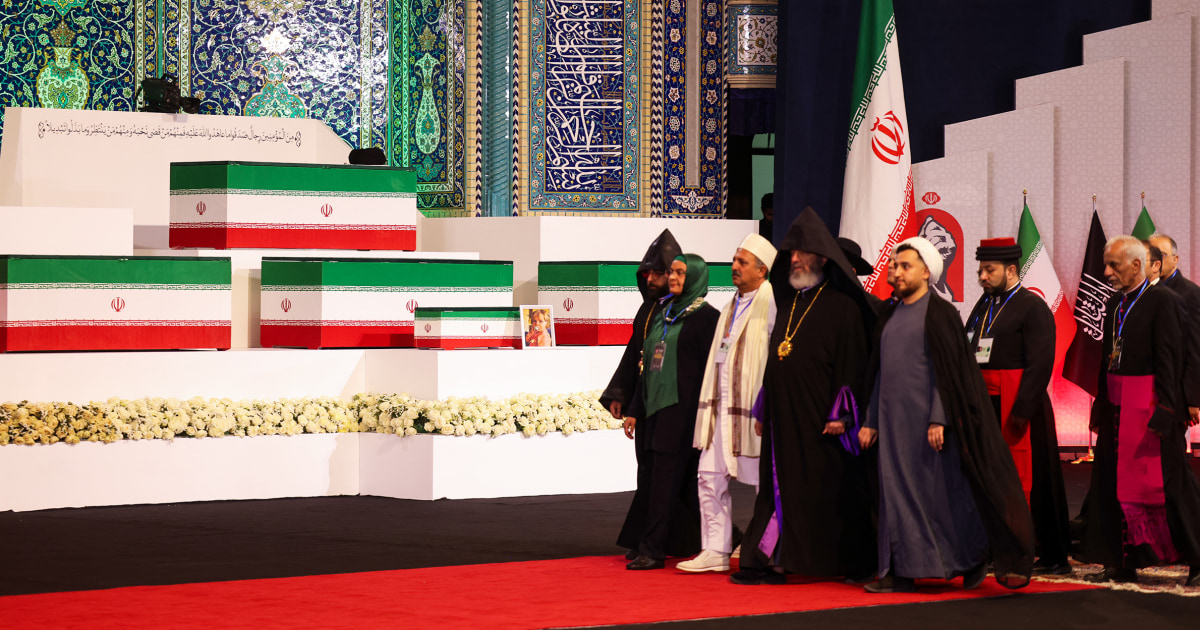
Iran is holding a multi-day funeral for former Supreme Leader Ayatollah Ali Khamenei, with viewings Saturday and Sunday at the Grand Mosalla, a procession Monday in Tehran and burial Thursday in Mashhad.
He was killed alongside members of his family in the opening salvo of U.S. and Israeli attacks on Tehran on Feb. 28, and he had controlled the Islamic Republic for nearly four decades. Khamenei was 86, and those killed with him included his daughter, son-in-law and a grandchild.
Tehran Mayor Alireza Zakani has said that up to 20 million people could show up; organizers are expecting between 15 and 20 million, and the mayor said it could be the biggest single event in the city’s modern history.
Photos published by Iranian state media Thursday night showed Gen. Ahmad Vahidi, who leads the paramilitary Islamic Revolutionary Guard Corps, after reportedly attending a meeting about Khamenei’s funeral. He was later seen sitting alongside the casket at a smaller service held near the late leader’s former home in downtown Tehran.
Iranian officials gathered in Tehran on Friday to pay early respects, and images showed a large crowd surrounding the coffin Friday morning, with some people weeping. Outside the Imam Khomeini Mosalla Grand Mosque members of the IRGC could be seen kneeling, and photos of Khamenei from his early years to his final days were on display across the capital.
Security and logistics measures have been heavy: streets were reported to have little traffic, shops that were open were expected to close during the official mourning, people were being told to leave cars on the highway on the outskirts and take buses into central Tehran, and public transportation was made free for the funeral events.
Khamenei’s 56-year-old son Mojtaba, who was wounded in the same attack that killed his father, was appointed the new supreme leader in March and took up the helm, but he has not been seen in public or issued an audio statement since. The government has not confirmed whether he will attend funeral events, and questions have swirled about his condition.
The delayed funeral, held four months after his death, departs from Muslim custom that funerals should be held soon after death; the 1989 funeral for Ayatollah Ruhollah Khomeini was held only days after he died. Security is a top concern: in 1989 Khomeini’s chaotic procession saw his body jostled out of the coffin and at least eight people died and many were injured, an Islamic State attack on a 2024 gathering in Kerman killed at least 84 people, and nationwide protests in January were met by a deadly crackdown that left thousands dead. The funeral date was confirmed last month days before a memorandum of understanding meant to mark an end to fighting was signed between the U.S. and Iran; since then efforts toward a lasting end to the war have faltered, with talks in Doha in recent days failing to yield significant results.
“They would like to portray it as a signal of the Islamic Republic’s strength, ability to resist outside pressure, resilience. They will try their best to show the loyalty of the quote-unquote people to the Islamic Republic. From whatever means possible, they will try to bring as many people as they can,” said Sina Azodi, director of the Middle East studies program at George Washington University. “We must rise up and convey the nation’s call for (avenging the blood of the martyred Leader) to the world so that the world knows that the noble nation of Iran will not remain silent in the face of oppression and arrogance,” said Mohammad Bagher Ghalibaf, the current speaker of parliament and lead negotiator in talks with the U.S. “The IRGC dominates strategic decision-making and the allocation of national resources,” said Ali Alfoneh, a senior fellow at the Arab Gulf States Institute. “Khamenei fortified the Islamic Republic against its external enemies, but in the process weakened the republican foundations on which its long-term legitimacy depended,” said Ali Vaez, Iran project director for the International Crisis Group, adding: “After war, leadership transition and the lingering trauma of a brutally suppressed uprising, the Islamic Republic enters a period of profound uncertainty.”
Foreign dignitaries were among those who joined officials and mourners in Tehran on Friday to pay their respects, including Pakistani Prime Minister Muhammad Shehbaz Sharif, who has served as a key mediator in the U.S.-Iran talks to end the war.