
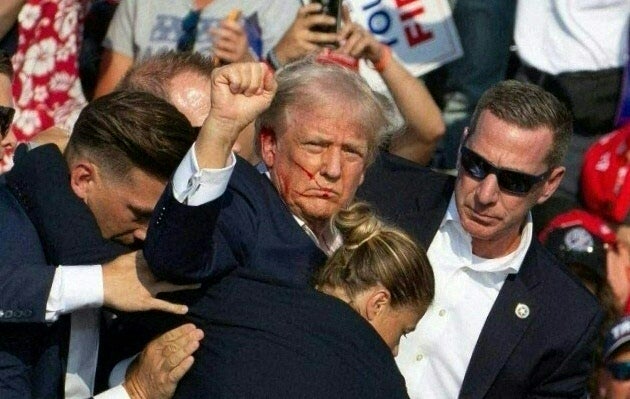
The Department of Homeland Security Office of Inspector General said in a report released Thursday that the Secret Service missed multiple opportunities to prevent the July 13, 2024, assassination attempt on Donald Trump at a campaign rally in Butler, Pennsylvania.
The 64-page document said Thomas Matthew Crooks fired eight shots during the attack, grazing Trump in the ear, killing Corey Comperatore, 50, and critically injuring two other spectators who survived; Secret Service agents rushed the stage and moved Trump to safety.
"The Secret Service’s overall lack of policy and processes coupled with limited intelligence sharing and poor collaboration and communication with protectee staff and state and local law enforcement set the conditions that led to missing opportunities to prevent and detect the attempted assassination," the report states, and it found the agency failed to warn Trump's protective detail that Crooks had a range finder and a long gun and had climbed onto a nearby roof.
The report said agents operated out of separate locations 257 yards apart with intermittent and highly limited radio connectivity and that the agency missed 102 radio transmissions about an increasingly intense search, including alerts that the suspect was on the roof with a long gun.
The inspector general's report found the agency remained unaware of the local radio transmissions in part because it did not establish a joint communications room with local law enforcement, and it said local authorities were actively receiving reports about the search for a suspicious person later identified as Thomas Crooks.
"Instead, we found that the Secret Service received only five phone calls and three text messages about Crooks," the Department of Homeland Security inspector general's report noted. "As a result, Secret Service members did not alert President Trump’s protective detail about concerns of a suspicious person."
The Secret Service failed to detect a drone Crooks flew less than three hours before the rally because the counter-drone system was inoperable, the report says. The system was manned by a single "under-trained" operator who did not test it before the event and who took hours to attempt to fix the issue; during that time the suspect conducted a nearly nine-minute drone flight 471 yards from the event stage at an altitude of 102 feet.
The report said the agency also failed to share intelligence with the Pittsburgh field office and agents on site, did not secure the area outside the security perimeter, and did not block a line of sight from the American Glass Research International building despite identifying the AGR complex as a vulnerability during advanced walkthroughs. Officials originally proposed using trucks already onsite to block the AGR view but Trump's campaign staff rejected the idea because it would interfere with press photographs; an agent proposed a secondary truck location but never verified that the campaign moved the equipment, leaving Crooks an unobstructed view of the podium from 155 yards, the report said.
"Communications was a problem because of inoperability. There were too many command posts," Paul Eckloff, a former Secret Service agent, said. "The biggest failure that is probably not addressed in the OIG report is that they never should have accepted the risk of doing it at this site. It never should have been done. That roof had an egregious line of site."
The report offered several recommendations to improve event security, including mandatory threat communication, enhanced counter-drone training and a process to formally document the identification and blocking of line-of-sight vulnerabilities.
The Secret Service said it concurred with the inspector general's recommendations. "Many of these recommendations were already identified ... and have since been implemented as part of our ongoing reform efforts," a spokesperson said.
The report said Crooks was shot and killed by law enforcement at the rally.
Thursday's report was the latest in a series of investigations by government watchdogs and congressional panels that identified major shortcomings in the Secret Service's security arrangements for the event.