
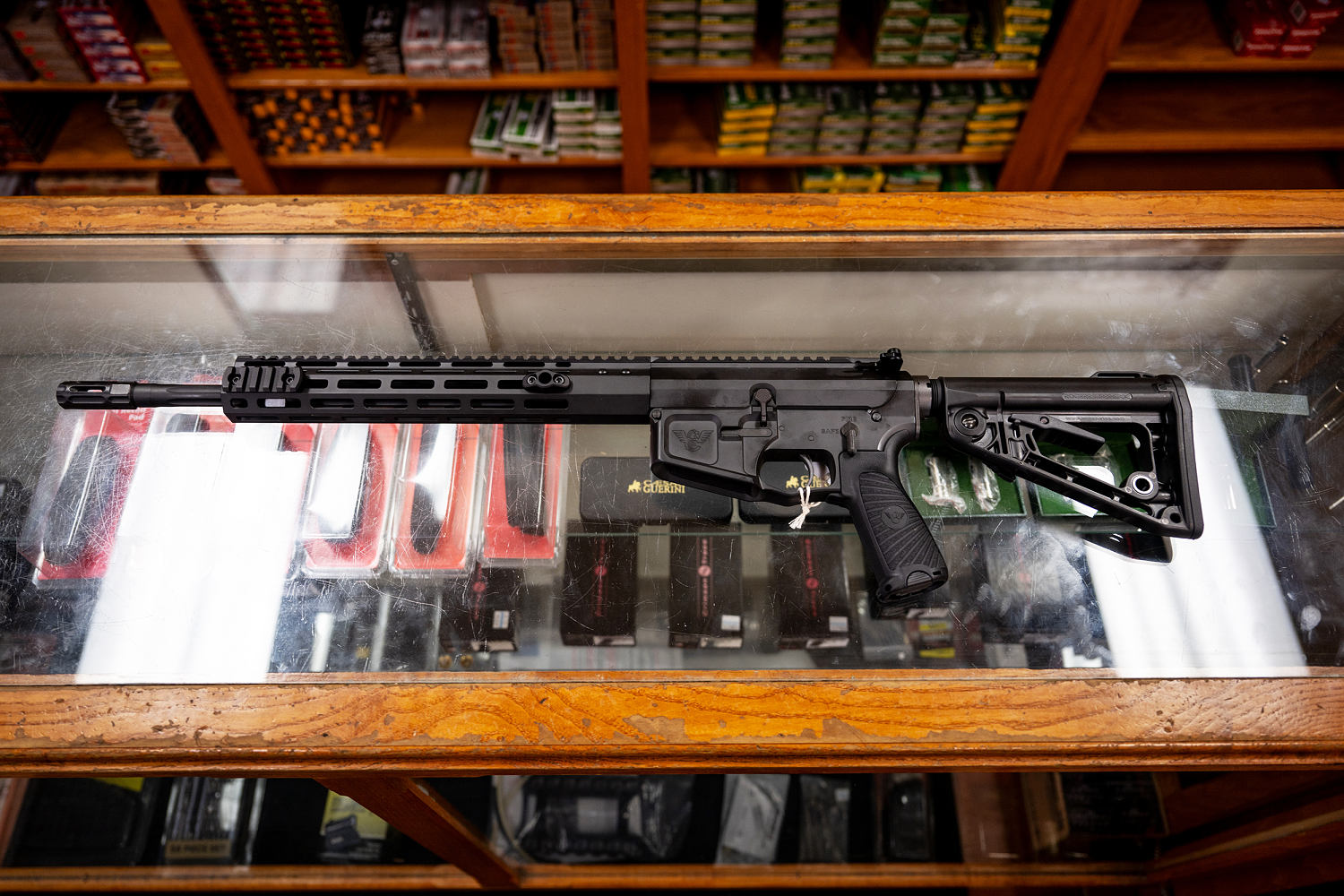
The Supreme Court on Tuesday agreed to decide whether states and local governments can ban semiautomatic rifles like the AR-15.
The justices said they will hear combined challenges to bans in Connecticut and Cook County, Illinois, and will argue and decide the cases in the court’s next term, which starts in October; the court has a 6-3 conservative majority that generally backs gun rights.
The Cook County challenge was brought by Cutberto Viramontes, Christopher Khaya, the Firearms Policy Coalition and the Second Amendment Foundation; the Connecticut measure was challenged by the Second Amendment Foundation, the Connecticut Citizens Defense League and three individuals.
AR-15-style weapons have been used in multiple high-profile mass shootings, including the 2012 Sandy Hook Elementary School shooting that killed 20 children and six adults and the 2022 Uvalde elementary school shooting that killed 19 children and two teachers; the Connecticut law was revised as a direct result of the Sandy Hook shooting.
Lower courts have upheld both laws, and the Cook County ban was first passed in 1993.
The court in a 2022 ruling expanded on the right to bear arms by ruling that the Second Amendment applies outside the home, and this term it struck down gun carry restrictions in Hawaii and a broad federal ban on gun ownership by marijuana users while having previously upheld some restrictions such as a law barring people under domestic-violence restraining orders from having guns.
When the court declined to hear a similar case last year, four conservative justices indicated they believed AR-15 bans are unlawful and Justice Brett Kavanaugh wrote, "in my view, this court should and presumably will address the AR-15 issue soon."
"These laws are critical public safety measures, and they are consistent with the Second Amendment," said Janet Carter, managing director of second amendment litigation at Everytown Law, while Adam Kraut, executive director of the Second Amendment Foundation, said, "The second amendment protects arms in common use for lawful purposes, and it’s hard to argue that a type of rifle that potentially outnumbers Ford F-150 trucks in America doesn’t meet that standard."
Cook County argued in its response that "For over three decades, the democratically elected officials of respondent Cook County, Illinois, have been faced with the overwhelming, mounting, and unrefuted evidence showing that assault rifles are the weapon of choice for criminals and terrorists set on quickly massacring innocents, but are rarely put to lawful public use."