
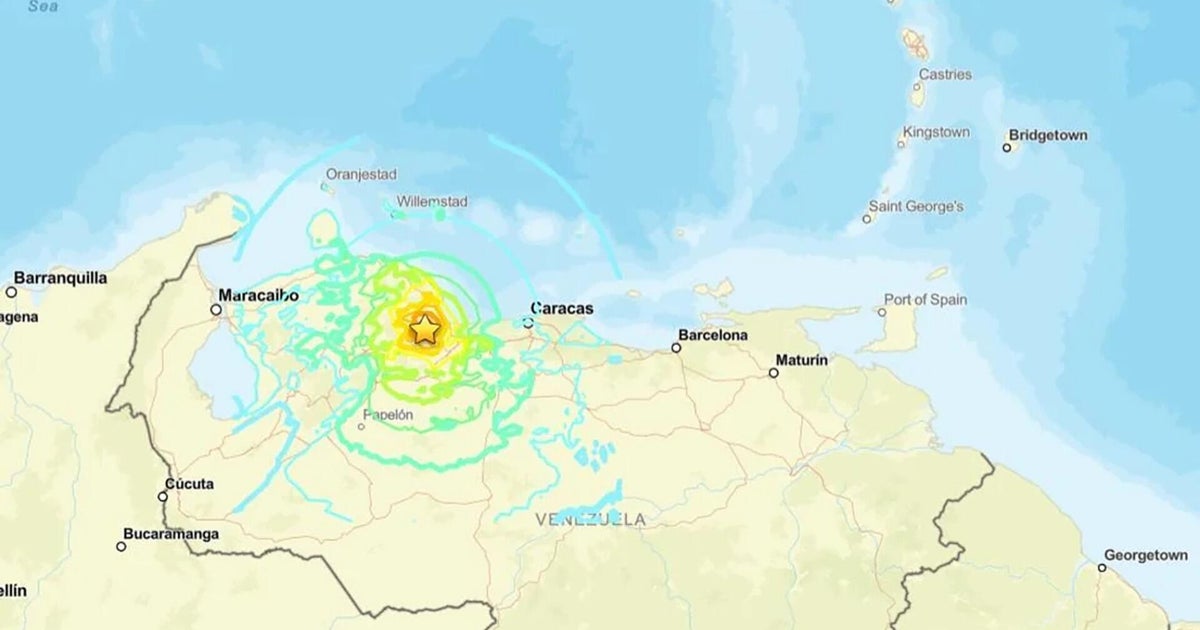
Two major earthquakes struck northern Venezuela Wednesday evening, killing at least 164 people and injuring 971, collapsing buildings in the capital, Caracas, the U.S. Geological Survey and Venezuelan authorities said.
The U.S. Geological Survey said an initial 7.2-magnitude foreshock struck at about 6 p.m. Eastern and was followed less than a minute later by a 7.5-magnitude earthquake; the agency said the epicenters were about three miles apart near the town of Morón on Venezuela's Caribbean coast, roughly 100 miles west of Caracas, and that the second shock struck near the town of Yumare about 39 seconds after the first.
The U.S. Geological Survey said its modeling estimated deaths could be in the thousands to tens of thousands and economic losses could reach billions to tens of billions of dollars, and that the 7.5 quake was the largest to hit Venezuela since 1900; the agency also warned that significant aftershocks were likely and forecast a 40% chance of a magnitude 6.0 or larger quake in the next week and an "almost certainty" of at least a magnitude 5.
Acting President Delcy Rodríguez declared a state of emergency and said the state of La Guaira had been turned into a "disaster zone" with "dozens of buildings" collapsed about 30 kilometers north of Caracas; she said the airport in Caracas had sustained heavy damage.
Photos and video showed leveled buildings and falling debris at Simón Bolívar International Airport in Caracas, which has been closed, and crews reported collapsed buildings in the Altamira and Los Palos Grandes neighborhoods; a reporter saw at least three buildings that had collapsed in Altamira.
Emergency responders were undertaking "intensive rescue operations" early on Thursday, searching for people thought to be under the rubble, Rodríguez said; her office had earlier received reports of at least 32 deaths and more than 700 injuries.
Rodríguez said 20 aftershocks had been recorded, and all schools and non-essential services were suspended.
U.S. officials said they were mobilizing assistance; U.S. Deputy Secretary of State Christopher Landau said the United States "stands with the Venezuelan people," and State Department official Jeremy Lewin said the U.S. would send search and rescue teams, medical and humanitarian supplies and other resources and had mobilized a disaster response team. President Donald Trump pledged support, saying he had "instructed all agencies of our government to get ready to move quickly," and Secretary of State Marco Rubio said the U.S. was "immediately deploying search and rescue teams, medical resources, and humanitarian assistance."
The governor of Falcón, Víctor Clark, said 15 people were being searched for in rubble in his state and 35 people were injured there.
The United Nations humanitarian affairs agency said almost eight million of the country's 28 million people were in need of assistance as of May.
Journalist Tony Frangie, who was in an elevator in Caracas when the first temblor struck, said the elevator let him out in the building's basement and that the structure ultimately stayed standing after he and neighbors evacuated; he said he had been on his way to watch a World Cup match and that he feared the death toll would rise as videos showed buildings collapsing and people searched for loved ones.
The shaking could be felt in parts of Colombia and Brazil, and the quakes sparked tsunami alerts.
Secretary of State Marco Rubio said the U.S. has already deployed search and rescue teams from Fairfax County, Virginia, and Los Angeles and that he had spoken to Rodríguez to offer the full assistance of the United States; he said Qatar and El Salvador had also offered assistance.
CBS News meteorologist Rob Marciano said the quakes were shallow, about six miles deep, producing more violent shaking at the surface.
In the coastal neighborhood of Catia La Mar, which holds nearly 200 housing towers, resident Yilsmaris Blanco said "everything, everything collapsed." Larry Rojas said his family was trapped in a collapsed building, and residents reported widespread power outages and lack of access to water. Jose Pacheco, operations chief of the United Rescue Group of Venezuela, said he had never seen anything like the aftermath in his 30 years of experience and called on specialized teams from Caracas, saying La Guaira needs "help, above all technical help."
Ana Vanessa Herrero, a journalist based in Caracas, told TODAY she witnessed the consecutive quakes and described difficulties and a lack of resources that rescuers are facing on the ground.