
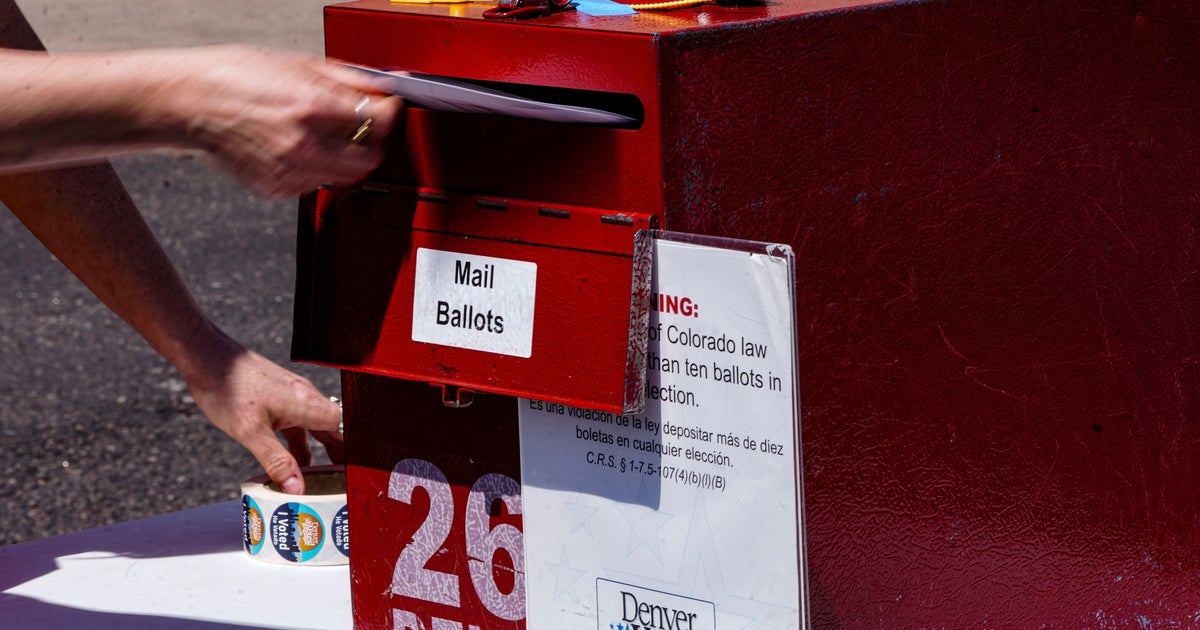
A U.S. appeals court on Saturday upheld a federal ruling that blocked President Trump's executive order to create a list of eligible voters and limit mail-ballot delivery in nearly half of U.S. states, rejecting the administration's effort to move forward with the mail-in voting restrictions in 23 states that sued ahead of November's midterm elections.
The 1st U.S. Circuit Court of Appeals issued a two-to-one decision saying, "Under the Constitution, state and local officials are responsible for administering federal elections." The majority added the order would impose "unprecedented levels of involvement by federal officials in how states administer elections" and would "sow confusion and threaten disenfranchisement of many eligible voters" if enacted by the November midterm elections.
The ruling followed an initial injunction ordered in June by U.S. District Court Judge Indira Talwani, who was nominated by former Democratic President Barack Obama and had halted the order from being implemented for the Nov. 3 elections but only in the states that sued.
The March executive order directed the director of U.S. Citizenship and Immigration Services and the commissioner of the Social Security Administration to create a "state citizenship list" of eligible voters and ordered the U.S. Postal Service to deliver mail ballots only to people on that list; the president said the proposed changes were safeguards to keep non-U.S. citizens from voting and said, "The cheating on mail-in voting is legendary," in the Oval Office before signing the order.
State election officials said the measures were ripe for abuse and could cause chaos, and Democratic officials and the District of Columbia filed a lawsuit in U.S. District Court in Boston arguing the order was unconstitutional because the states and Congress, not the president, have the authority to set election rules.
After the appeals court decision, the Trump administration on Monday asked the Supreme Court to intervene, filing an emergency request to allow the mail-in voting restrictions to be implemented.
The First Circuit's injunction applies only to the 23 states that sued, a split that followed a D.C. federal appeals court lifting a broader injunction last week and a Washington state appeals court setting aside a similar ruling a week earlier, a sequence that has left it unclear whether the Postal Service will attempt to make the changes in states not covered by the Massachusetts injunction.
The Postal Service in June proposed a rule to create state lists of approved voters and impose stricter regulations on mail-in ballots, and Postmaster General David Steiner told Congress in June that under the proposed rule the Postal Service would refuse to deliver ballots in states that refuse to enforce the new changes. When asked by a senator, Steiner replied, "Under our proposed regulation, no. We would tell the state that we need the manifest."
Daniel Griffith, senior director of policy at Secure Democracy USA, said he did not think anything stopped the administration from going through with the rulemaking and enforcing the rule in the states that are not covered by the Massachusetts injunction.
An analysis cited in court filings found mail-voting fraud to be very rare: a November 2025 Brookings Institution analysis estimated an average total mail-voting fraud percentage across several general elections of 0.000043 percent, or about four cases of mail voting fraud out of every 10 million mail votes, and the Heritage Foundation database shows 387 instances of fraudulent use of absentee ballots recorded since 1982.
A Postal Service spokesperson said, "Because of pending litigation, we have no response to offer on any questions related to the Executive Order or the proposed rule." The White House and the Justice Department did not immediately return an email message seeking comment Sunday.