
The Trump administration will impose 25% tariffs on certain imports from Brazil beginning July 22, it announced.
The action was taken under Section 301 of the Trade Act of 1974 after a yearlong Office of the U.S. Trade Representative investigation that cited practices including orders directing American technology firms to remove political content, preferential tariffs for Mexico and India, weak intellectual property enforcement and ethanol market barriers.
U.S. Trade Representative Jamieson Greer said, "Whether it is punishing U.S. technology companies for refusing to censor political speech, backsliding on anti-corruption enforcement, or allowing Brazilian farmers to exploit illegally logged land to gain an advantage over American farmers, Brazil's unfair trading practices have prevented U.S. workers and producers from accessing this important market with over 210 million consumers."
The order exempts goods that are not produced in the U.S. or that officials worried would disrupt supply chains; exempted products include coffee, beef, oranges and orange juice, some oil and gas energy products and aerospace parts and components, as well as aircraft and parts.
A separate U.S. probe into forced-labor enforcement could add an additional 12.5% duty on Brazilian goods on top of the 25%, with a decision due next week.
Senior administration officials said the tariffs were targeted to goods that could not be duplicated in the U.S. and that would not disrupt the economy; they dismissed assertions that politics drove the decision, saying U.S. negotiators had given Brazil time to address grievances and had only begun having constructive meetings in the last six weeks, though not enough progress was made.
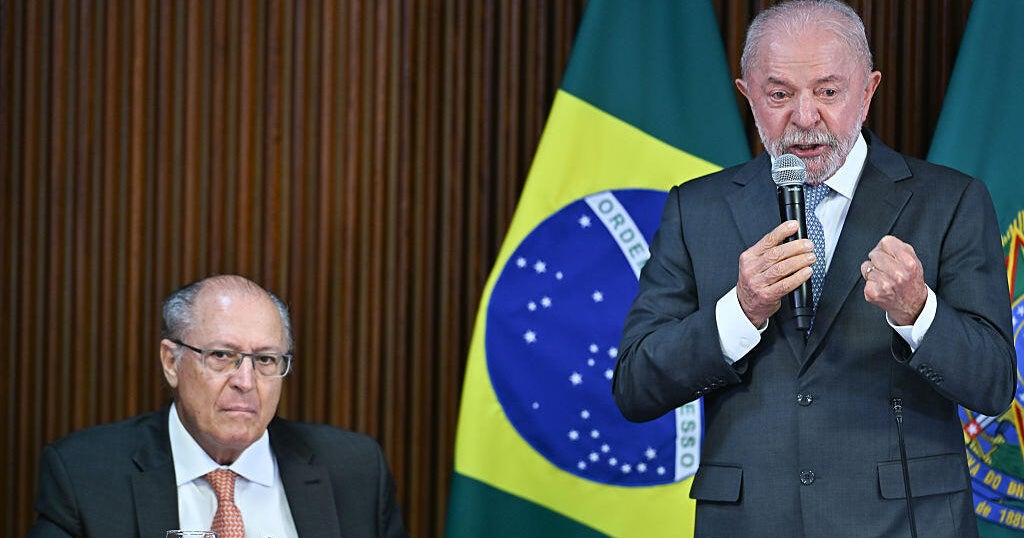
Brazil's President Luiz Inacio Lula da Silva rejected the decision, denied "the alleged unfair trade practices" and said, "There is no justification for unilateral measures against our country," while vowing to initiate countermeasures and to raise the dispute at the World Trade Organization.
In a statement late Wednesday, Lula's office said 76% of imports from the United States entered Brazil duty-free in 2025 and that the average tariff effectively applied to U.S. products was only 3.1%. It said Brazil "will immediately begin the procedures necessary to invoke the mechanisms provided for under the reciprocity law ... and will also pursue the matter through the World Trade Organization's dispute settlement mechanism." The statement added, "Brazil does not recognize the legitimacy of investigations that are not grounded in the multilateral rules governing international trade."
The United States' trade position with Brazil last year was marked by a surplus: U.S. exports to Brazil exceeded imports by nearly $42 billion, the government statement said.
Brazil's National Confederation of Industry said the new tariff puts pressure on national exports and increases insecurity for companies in both countries, and U.S. officials first proposed the tariff last month.
The tariffs follow a February U.S. Supreme Court ruling that struck down many of former President Donald Trump's tariffs imposed under the International Emergency Economic Powers Act, overturning a prior 50% levy on Brazil and leaving only a 10% global tariff in place. The Trump administration first imposed a 50% tariff on Brazilian imports last July, at the time citing what it called a "witch hunt" against former President Jair Bolsonaro while an ally was on trial for attempting a coup and was later convicted; some of those tariffs were later rescinded.
Secretary of State Marco Rubio posted on X that Lula's government had "not negotiated in good faith" and called the tariffs the price of Lula "putting his own ego ahead of making a deal."
Sen. Flávio Bolsonaro reposted Rubio's statement and wrote, "Lula is no longer fit to be the president of Brazil. We are on a plane without a pilot." He called Lula "the Brazilian Biden" and said he "is grumpy, reckless, and has become a danger to our nation."