
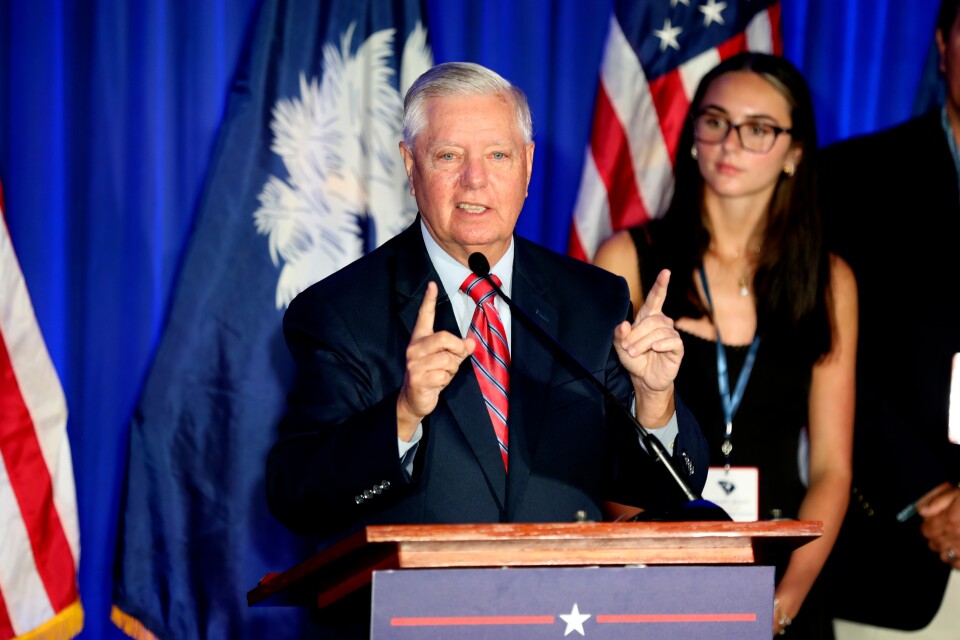
On the evening of Saturday, July 11, U.S. Sen. Lindsey Graham died after a brief and sudden illness, and a preliminary report from the District of Columbia medical examiner found he died of an aortic dissection due to arteriosclerotic cardiovascular disease, his spokesperson said Sunday. He was 71. His spokesperson said the death certificate would be pending until "all the toxicological and microscopic testing" was finalized.
Dr. Roberto Aru, an assistant professor of vascular surgery at Thomas Jefferson University, said an aortic dissection is a life-threatening condition that requires rapid diagnosis and that emergent surgery can be necessary depending on the location of the tear and any associated poor blood flow to organs. He said patients often present with sudden, severe chest or back pain described as the worst pain of their life with a ripping or stabbing sensation and that anyone with symptoms resembling a heart attack should seek emergency care.
The condition occurs when a tear in the inner layer of the aorta allows blood to flow between layers of the vessel wall and can prevent adequate blood flow to organs or lead to rupture. There are two types: type A dissections involve the ascending aorta near the heart and are more common and often more severe, while type B dissections occur in the descending thoracic aorta; type B cases without complications may be managed initially with medications to lower blood pressure and heart rate but require close monitoring and sometimes surgery.
Risk factors include smoking, high blood pressure, genetic connective tissue disorders and trauma, and about 10,000 people died in 2019 from an aortic dissection or an aortic aneurysm, according to the Centers for Disease Control and Prevention. Doctors say people can lower their risk by managing blood pressure and avoiding smoking.
A newly released statement and photo of the 84-year-old Sen. Mitch McConnell prompted fresh scrutiny of his health and renewed questions about who will replace Graham in South Carolina.
Graham was running for a fifth term when he passed away and had served as the conservative state's senior senator and an influential ally of President Donald Trump. He was elected to the Senate in 2002 and had been one of Washington's most influential voices on foreign policy, often pushing for U.S. military intervention overseas.
He had just returned from a trip to Kyiv, Ukraine, where he met with President Volodymyr Zelensky on Friday. Zelensky wrote on X that he was "deeply saddened," calling Graham "a true defender of freedom and the values that make our world safer."
Israel's Prime Minister Benjamin Netanyahu said on Sunday, "Lindsey understood that the security of Israel and America are inseparable," and that Israel had lost "one of its greatest friends." Graham was known for his interventionist stance on foreign policy and had strongly supported the war in Iran; last month he told CBS that the U.S. would "obliterate" Iran if it did not submit to U.S. control of the Strait of Hormuz.
Graham had previously been a critic of Trump and ahead of the 2016 presidential election said, "If we nominate Trump, we will get destroyed... and we will deserve it." He voted against convicting Trump in his 2021 impeachment trial and supported Trump's election in 2024. In 2023 he told the BBC, "There is a dark side to Donald Trump... and he was a very good president. But I am sticking with him because I saw what he did."
Gov. Henry McMaster must choose a temporary replacement who can serve until January while the state prepares a special primary for voters to pick a new Republican nominee for the general election.
Under South Carolina law, a one-week filing period for a special primary begins on the second Tuesday after a candidate’s death, or July 21. The special primary would be held on the second Tuesday after that filing period closes, or Aug. 11, with any necessary runoff two weeks later, or Aug. 25. The new nominee would then have just over two months to campaign for the Nov. 3 general election.
Federal law requires that military and overseas ballots go out 45 days before any federal election, a timing requirement that officials say complicates the process; Federal Election Commission officials did not immediately respond to a request for clarity.
Republicans had just finished a bruising contest for the nomination to succeed McMaster, with State Attorney General Alan Wilson winning the nomination over a field that included Lt. Gov. Pamela Evette, Rep. Nancy Mace and Ralph Norman; those figures are now eyeing Graham’s seat. Evette, who served nearly eight years alongside McMaster and received his endorsement in the governor’s race, lost the June 23 runoff to Wilson and has received encouragement to enter the special primary, a person with knowledge of her thinking said.
Broad speculation about appointments and candidacies followed Graham's death. It is unlikely that any House member would be appointed to finish Graham’s current term because of Republicans' slim majority in the chamber. U.S. Rep. Joe Wilson said he assured Trump on Sunday that "my goal is to remain in the House to keep his two-vote majority for the American people!!!" A person with knowledge of Rep. Nancy Mace’s thinking said she was considering the race. Rep. Russell Fry was mentioned as a possible contender, and Treasury Secretary Scott Bessent has fielded calls about possibly replacing Graham but does not have interest in the role, a person familiar with private conversations said. A spokesman for businessman Mark Lynch did not return a message.
No Democrat has won a Senate seat in South Carolina in decades, and Republicans typically win statewide races by double digits. Charleston pediatrician Annie Andrews, who won the Democratic nomination last month, had raised more than $8 million and had just under $3 million cash on hand at the end of May, according to federal filings; Graham had taken in $6 million with just over $4 million on hand. In a statement Sunday, Andrews called on South Carolinians to join her "in setting partisanship aside and offering gratitude" to Graham for his service, and former Democratic nominee Jaime Harrison wrote that he "always appreciated that even in our fiercest political battles, we could still share a conversation, a laugh, and a mutual respect" with Graham.
Graham served more than two decades in the Senate, where seniority can determine influence. Sen. Tim Scott, South Carolina’s junior senator, who co-chaired Graham’s reelection effort, described him as "irreplaceable" and said, "America lost a statesman, but I lost a friend," on a national news program. Scott has been in office since 2012; former Sen. Fritz Hollings served 38 years and Strom Thurmond served 47.
Before Graham's death, Republicans held a 53-47 majority over Democrats in the Senate, and both parties are fighting for control in November.
President Donald Trump on Monday recommended that Gov. Henry McMaster appoint Graham's sister, Darline Graham Nordone, to serve the remainder of his Senate term, writing on social media, "I recommended, to Governor Henry McMaster, Lindsey Graham's wonderful sister, Darline, to serve as interim Senator from the Great State of South Carolina. This would be a fabulous tribute to Lindsey, who loved her dearly!"
McMaster will hold a 4 p.m. press conference Monday afternoon from his office in Columbia to announce his selection; his office said the person he selects will serve until at least Jan. 3, finishing Graham’s current term.
One Republican familiar with McMaster’s plans said the governor intends to appoint Nordone to serve in the Senate for the rest of the year.
Republican Sen. Tim Scott said Nordone "would be a wonderful placeholder." A source familiar with the talks said Scott has spoken to Nordone multiple times in the past 24 hours and is expected to be on hand for the announcement, and the interim senator is set to be sworn in on Wednesday.
It is unclear whether Nordone would want to run for the full six-year term even if she is appointed, a development that would leave the Aug. 11 special primary to determine the Republican nominee for the November general election.