
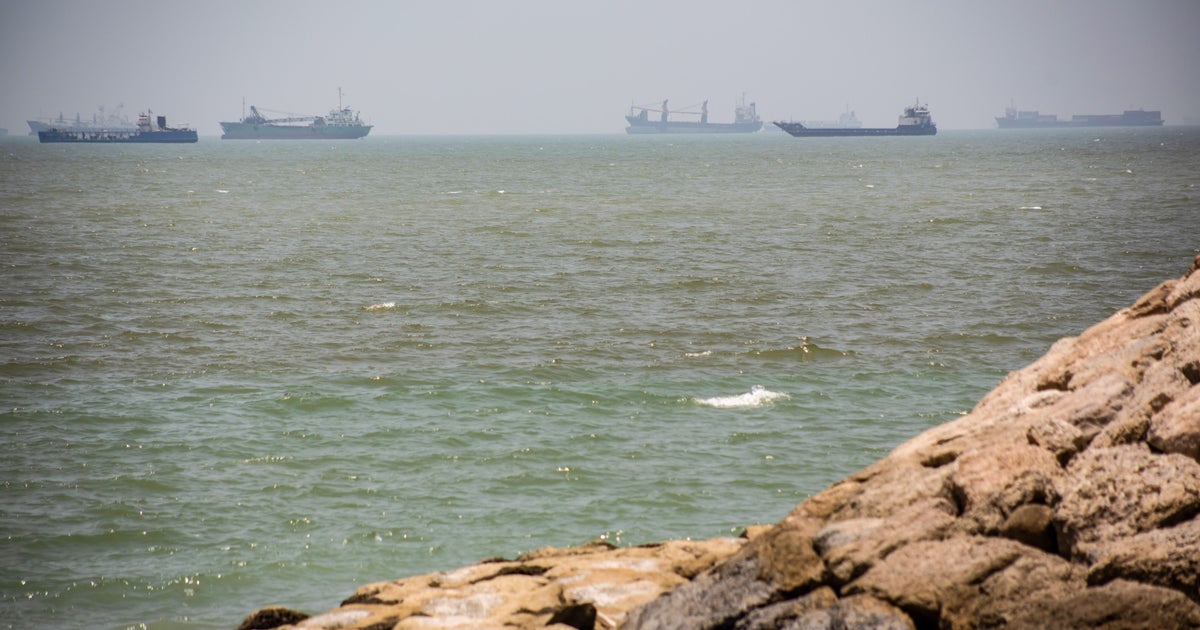
U.S. forces began launching strikes July 7, 2026, against Iran to retaliate for attacks on three commercial vessels in the Strait of Hormuz, U.S. Central Command said, and Iran retaliated with strikes targeting Bahrain and Kuwait.
U.S. Central Command said on X, "U.S. Central Command forces have begun launching a series of powerful strikes against Iran to impose heavy costs for targeting and attacking commercial shipping crewed by innocent civilians in an international waterway." It said it hit Iranian air defense systems, radars and more than 60 small boats used by Iran's paramilitary Revolutionary Guard, and added that this round of attacks had ended.
Garrett Haake said the U.S. launched retaliatory airstrikes on July 7, 2026 after the Iranian regime violated the ceasefire and targeted commercial ships in the Strait of Hormuz.
A U.S. official said the military was targeting air defenses, coastal surveillance sites, surface-to-air missile sites, anti-ship cruise missile sites, drone launch sites and port facilities, and that strikes were being carried out with Air Force jets and Navy tactical aircraft.
The U.K. Maritime Trade Operations agency issued warnings of one attack on Monday and two Tuesday without naming the vessels; it said one attack was carried out by an uncrewed aerial vehicle while the other two tankers were targeted by unknown projectiles. The U.K. agency said one tanker traveling off Oman was hit and caught fire and that two other ships sustained some damage but no one was injured and both continued on their way. The ships attacked all appeared to be using a route close to Oman's shore rather than one ordered by Tehran, and Iranian state television said the liquefied natural gas tanker came under attack after it ignored warnings. Majed al-Ansari, a spokesperson for the Qatari Foreign Ministry, said the Qatari tanker Al Rekayyat was targeted in an "unacceptable attack" on international navigation and said Qatar holds Iran "fully legally responsible."
A U.S. official said the Office of Foreign Assets Control is revoking GL X, which authorized the sale of Iranian oil, and the Treasury Department listed the revocation of a waiver of temporary sanctions as effective immediately, saying any production, delivery or sale of Iranian oil must be wound down by July 17. The revocation stripped the Islamic Republic's ability to openly sell crude oil on the world market and had ended a measure that had allowed Iran to conduct sales in U.S. dollars for the first time in years, officials said; Iran has been suspected of selling sanctioned crude at below-market prices to China.
The attacks on shipping and the resulting strikes came during the dayslong funeral for Iran's Supreme Leader Ayatollah Ali Khamenei, whom reporting said was killed Feb. 28 in the war's first moments at age 86; the funeral was due to end Thursday. Negotiations to reach a final deal had been due to start after Khamenei's burial and focus on fully reopening the strait and rolling back Tehran's disputed nuclear program, but the new attacks have cast that into question. As part of the interim understanding, Iran and the United States had agreed to allow ships to pass without paying charges for 60 days, but Tehran has insisted it must control vessels' routes and later charge fees; U.S. and Gulf Arab states say they will not agree to Iran charging for passage.
Deputy Foreign Minister for Legal and International Affairs Kazem Gharibabadi said the U.S. revocation of Iranian oil sales licenses "constitutes a blatant violation of Article 10, and the subsequent military operations of this country against Iran also constitute a serious violation of Articles 1 and 2 of the Islamabad Memorandum of Understanding," and warned Iran would "take decisive actions to safeguard its national interest and security" because of Israel's actions in Lebanon and the U.S.' "threatening statements against Iran." Iran's Guard issued a statement calling the U.S. "the child-killing and terrorist U.S. army" and said the strikes openly violated the ceasefire; Iran's Parliament Speaker Mohammad Bagher Qalibaf wrote on X, "The era of bullying and extortion is over. It leads nowhere. We don't fold."
Iran acknowledged the U.S. strikes but offered no word on losses. Iranian state media reported the sound of explosions in Bandar Abbas, Qeshm and Sirik, and U.S. officials verified a video showing multiple explosions at a port in Bandar Abbas. Wednesday morning both Bahrain and Kuwait sounded missile alerts, with Bahrain issuing a second alert later in the morning.
President Donald Trump said the interim ceasefire deal with Iran "is over," adding, "To me, I think it's over," and "I don't want to deal with them anymore." He said negotiations could continue but that he considers them a "waste of time," speaking on the sidelines of the NATO summit in Ankara, Turkey.
Oil prices surged and U.S. stock futures dropped after Trump's comments and the renewed strikes. U.S. crude jumped more than 6.5% to $75 per barrel and Brent rose 6.2% to almost $79 per barrel. S&P 500 futures and other major U.S. equity benchmarks pointed to declines at the opening bell, and travel and airline stocks were among the hardest hit. Capital.com market analyst Daniela Hathorn said renewed tensions had prompted investors to reassess geopolitical risks and lifted oil prices while weighing on equity markets.