
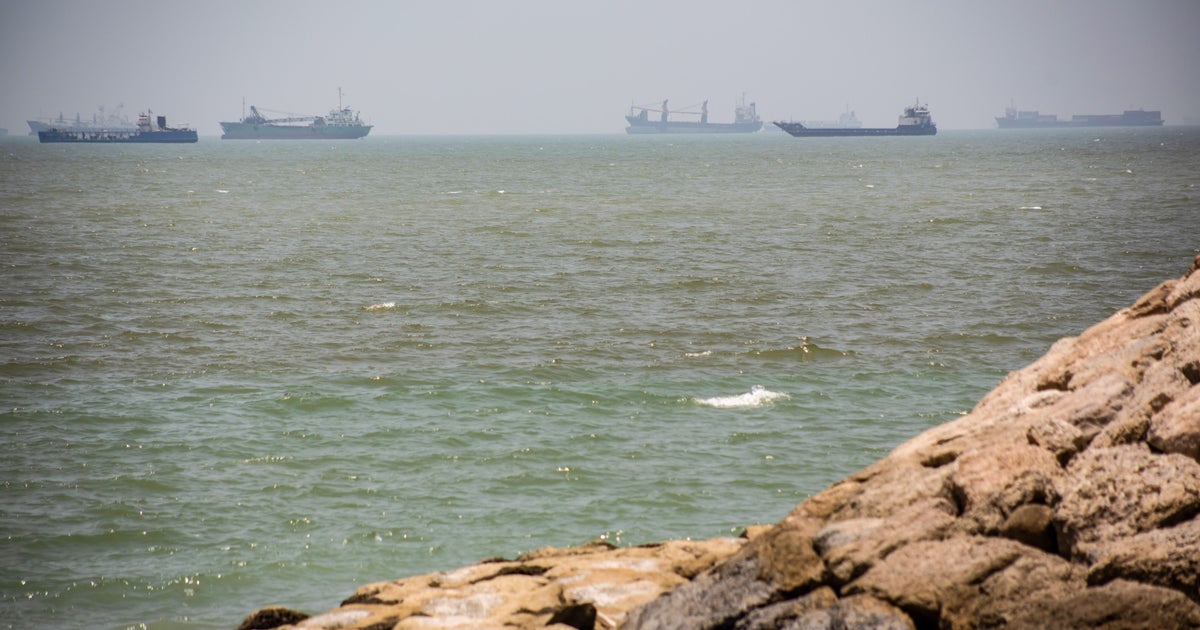
Iran's embassy in the U.K. said Monday it had established a temporary safe and secure maritime corridor, free of technical and military barriers, through the Strait of Hormuz and had notified the United Nations' International Maritime Organization, indicating a reopening from Tehran's perspective, and U.S. Central Command said at 4:45 p.m. ET it began launching the third consecutive night of strikes against Iran at the commander in chief's direction.
U.S. Central Command said Sunday evening its forces hit "dozens of targets at multiple locations" using precision munitions.
The United States attacked Iran into early Sunday morning, setting the container ship ablaze and forcing its crew to abandon it, and Iran apparently responded with strikes targeting Bahrain, Qatar and the United Arab Emirates; the UAE warned the public of an incoming missile and drone attack, Qatar said it intercepted incoming Iranian fire and missile alerts sounded in Bahrain.
The vessel was a Cyprus-flagged container ship identified by U.S. Central Command as the M/V GFS Galaxy, and CENTCOM and a U.S. official said it had been traveling on a route hugging the shoreline of Oman before suffering a fire and significant engine-room damage that left it unable to continue; one civilian crew member is missing. The U.K. Maritime Trade Operations agency said the ship was nine nautical miles east of Oman and that damage to the rear of the vessel caused the fire onboard.
CENTCOM said the strikes were intended to curb Iran's ability to target commercial shipping and that U.S. forces had launched more than 170 strikes over two days in response to alleged Iranian attacks on commercial shipping. CENTCOM said its forces carried out a round of strikes that hit at least 140 targets, including missile and drone sites, naval capabilities, ammunition depots, communication networks and coastal surveillance locations.
CENTCOM said President Donald Trump directed the strikes and that "The United States is imposing a heavy cost by continuing to degrade Iran's ability to attack civilian mariners and commercial ships freely transiting the strait." CENTCOM later declared the strait open, saying "Iran does not control the Strait of Hormuz," that "It remains an international waterway. U.S. forces are positioned and prepared to keep it that way," and that "Traffic is flowing."
The Islamic Revolutionary Guard Corps had said the strait was closed "at least until the end of US interference in this region," and said the vessel it struck had been traveling on an unapproved route, had "switched off its systems" and was "brought to a halt." The corps warned any retaliation would be met with a "severe response," said it had struck and disabled a second vessel, and said it had targeted the U.S. air base at Al Udeid in Qatar, destroying the base's fighter jet maintenance center and its command and control facility. The Revolutionary Guard also said it responded to American strikes by hitting military targets in Jordan, Kuwait, Qatar and Oman and that ballistic missiles were fired at Jordan's Prince Hassan Air Base, and it warned that "additional enemy bases in the region will be targeted."
Iranian state media said U.S. attacks apparently targeted Bandar Abbas and Sirik, as well as other areas along the shores of the strait, and reported explosions in several locations, including Bushehr, and quoted local official Ehsan Jahanian as accusing the U.S. of striking near the nuclear power complex.
The exchange of attacks widened beyond Iran's borders: Kuwait's military said falling debris wounded one person as it shot down three ballistic missiles, a cruise missile and 10 drones, and Jordanian government spokesperson Mohammad al-Momani said all incoming fire from Iran had been intercepted.
Diplomatic efforts continued: Iranian Foreign Minister Abbas Araghchi held telephone calls with senior regional officials, including the foreign ministers of Oman, Turkey and Saudi Arabia and Pakistan's army chief, mediators from Qatar, Pakistan and other nations have been working to revive talks, and Oman said it and Iran agreed to keep talking about the Strait of Hormuz at the technical and political levels. Tehran said Araghchi met Oman's Sayyid Badr Albusaidi in Muscat to exchange views on mechanisms for the safe passage of ships through the strait.
After President Trump's announcement about tolls on passage, Araghchi responded on social media saying Iran has "always been the GUARDIAN of the Strait and will remain so FOREVER" and adding "20% is of course too much. We will be fair."
The White House had given Tehran until Saturday to publicly acknowledge the shooting at ships was a mistake and to affirm that the strait would be open, and President Trump directed a negotiating team led by Vice President JD Vance, Jared Kushner, special envoy Steve Witkoff and Secretary of State Marco Rubio to continue talks scheduled in Oman on Saturday.
President Trump suggested the interim deal in the Iran war was "over," and he wrote on social media that "1000 Missiles are Locked and Loaded and aimed at the Islamic Republic of Iran, with thousands of more to immediately follow." He said the U.S. military would automatically retaliate if he were killed and that such retaliation would have to be ordered by Vice President JD Vance; he also wrote that he had issued instructions for the military in the event of his death and signed off a post "PRAISE BE TO ALLAH!" U.S. Defense Secretary Pete Hegseth wrote online, "Iran made a poor choice. Now they pay." U.S. Ambassador to the United Nations Mike Waltz said that "all options are on the table" and that Iran "is not living up to" the preliminary agreement negotiated in June. Mohammad Bagher Ghalibaf, speaker of Iran's parliament, warned the U.S. to maintain its end of the interim peace deal "or pay the price," writing on X, "The era of one-sided deals is OVER. We told you: keep your word or pay the price."
Mostafa Hosseini Khamenei led the funeral prayer as his father was buried in Mashhad, and Supreme Leader Ayatollah Mojtaba Khamenei vowed in his first statement since the funeral that revenge would be carried out. NBC News reported that Mojtaba Khamenei was seriously wounded in the attack that killed his father Feb. 28, has not been seen since the war began and that no photo or audio recording of him has been released; the late supreme leader was laid to rest at the shrine of Imam Reza on Thursday, marking the end of six days of public mourning ceremonies.
The strikes in Iran over two days — and prior to the ones in the wake of the warning shot — killed at least 17 people and wounded 115 others, Iranian Health Ministry spokesperson Hossein Kermanpour said.
The Strait of Hormuz is long considered an international waterway, but Iran has insisted that the strait remain under its control and that it be allowed to charge ships moving through it; the U.S. urges mariners to transit on a southern route through Oman's territorial waters, and about a fifth of all traded oil and natural gas passed through the strait before the war began. Iranian Foreign Minister Abbas Araghchi accused the U.S. of violating the interim deal by ending waivers that allowed Iran to sell crude oil on the open market in U.S. dollars, and those waivers were ended by Washington in response to the attacks on ships in the strait. A spokesperson for Australian Foreign Minister Penny Wong urged Iran to uphold the ceasefire agreement and to ensure safe passage through the Strait of Hormuz.
The Council on American-Islamic Relations criticized what it called President Trump's "deranged mocking of Islam" over his social media sign-off.
CENTCOM said the latest round of strikes brought the total targets hit over three nights to more than 300, and on Sunday morning CENTCOM said the waterway was open and "traffic is flowing." CENTCOM said American forces struck Iranian military air-defense systems, coastal radar sites, missile and drone capabilities and small boats, and that American forces used U.S. fighter aircraft, naval vessels and one-way attack aerial and one-way attack sea drones for the first time in the campaign.
On Monday the price of Brent crude rose about 4.7% to $79.59 per barrel, while U.S. benchmark crude added about 4.8% to $74.85 per barrel.
Oil prices had also been reported earlier to have surged on Monday morning, with Brent crude futures with September delivery advancing 4% to $79.02 per barrel and U.S. West Texas Intermediate futures with August delivery gaining 4.1% to $74.27 per barrel.
By Monday evening the international benchmark for oil climbed further after President Trump announced the renewed naval blockade, with Brent crude futures above $83 a barrel, and AAA said the average price of regular gas in the U.S. was $3.87 a gallon. Kpler said crossings through the Strait of Hormuz have dropped by more than half from the previous week.
Sirens sounded for the third time in Bahrain on Monday.
Iran's embassy in London accused the United States of having "done nothing but violate the MoU since day one," saying Washington had pushed vessels toward a dangerous southern parallel route close to Oman's coast and that the U.S. had "turned the Strait of Hormuz into a tense, high-risk zone for maritime traffic." The embassy said the implemented corridor was "in compliance with" the memorandum of understanding signed with the U.S.
Iran said it would not agree to a resumption of international inspections at some of the country's nuclear facilities, and Foreign Ministry spokesman Esmaeil Baqaei said the regime would not accept IAEA access.
Explosions of unknown origin were heard in southern Iran near the Strait of Hormuz on Monday, the semi-official Mehr news agency reported, saying media and residents reported hearing explosions near Bandar Abbas and the island of Qeshm at midday.
United Nations Secretary-General António Guterres warned of "catastrophic consequences" for the region if fighting resumes and said the attacks "must all stop."
Jordan's military said it shot down four Iranian missiles over the country, with no reports of injuries or damage, and Kuwait's Army Headquarters said its air defenses were again confronting hostile aerial targets within Kuwaiti airspace.
Global ship tracking firm Kpler said traffic through the Strait of Hormuz has slowed in recent days, with 14 ships crossing the waterway on July 12 compared with 24 ships on July 11.
President Donald Trump wrote on his Truth Social account that the United States was "reinstating THE IRANIAN BLOCKADE," would prevent ships from leaving or entering Iranian ports and would be "reimbursed, at the rate of 20% on all cargo shipped" for providing security, saying the U.S. would be "the guardian of the Hormuz Strait."
U.S. Central Command said the blockade would begin on Tuesday at 4 p.m. ET, that it did not mention fees, and that mariners approaching the Gulf of Oman and Strait of Hormuz should contact U.S. naval forces on bridge-to-bridge channel 16; CENTCOM said additional information would be provided to commercial mariners through a formal notice.
A U.S. defense official said the military has plans for several days of additional strikes in the Hormuz area and on Iran's southern coastline intended to degrade the Islamic Revolutionary Guard Corps' ability to attack ships, and said the southern route through the strait remained open with at least 20 ships transiting in coordination with the U.S.
U.S. crude oil surged about 5% to more than $75 per barrel and international Brent crude rose about 5% to $80 per barrel; stocks fell, with the S&P 500 down 0.5% and the Nasdaq hitting its lowest level of the day.
The U.S. Treasury Department warned that anyone who pays Iran for passage through the Strait of Hormuz would expose themselves to sanctions violations, calling such payments "maritime extortion."
A senior Gulf source said the U.S. had not discussed the issue of possible tolls for securing the Strait of Hormuz with its regional allies.
The U.S. military last worked to block maritime traffic to and from Iranian ports from April 13 to June 18.