
The Agriculture Department announced Wednesday that the New World screwworm had been found in Texas cattle, prompting plans to renew the U.S. campaign to control the parasitic fly.
The department said the discovery was the first natural incursion into U.S. cattle since 1982 and that it reported a second case Friday found about six miles from the first infection.
The species consumes the tissue of warm-blooded animals, poses a particular threat to livestock and is often fatal for cattle. "There are some species that it’s worth considering wiping out altogether and I do think the screwworm is one," said Gregory Kaebnick, a senior research scholar at the Hastings Center for Bioethics.
The control strategy is to mass-produce sterile males and release them because female screwworms only mate once. "It is a tremendous strategy. It has worked and will continue to work moving forward," said Chad Cross, a professor of parasitology at the Texas Tech University School of Veterinary Medicine, who added that the new Texas case "is a stark reminder of how quickly we need to act to ensure that it doesn’t spread further."
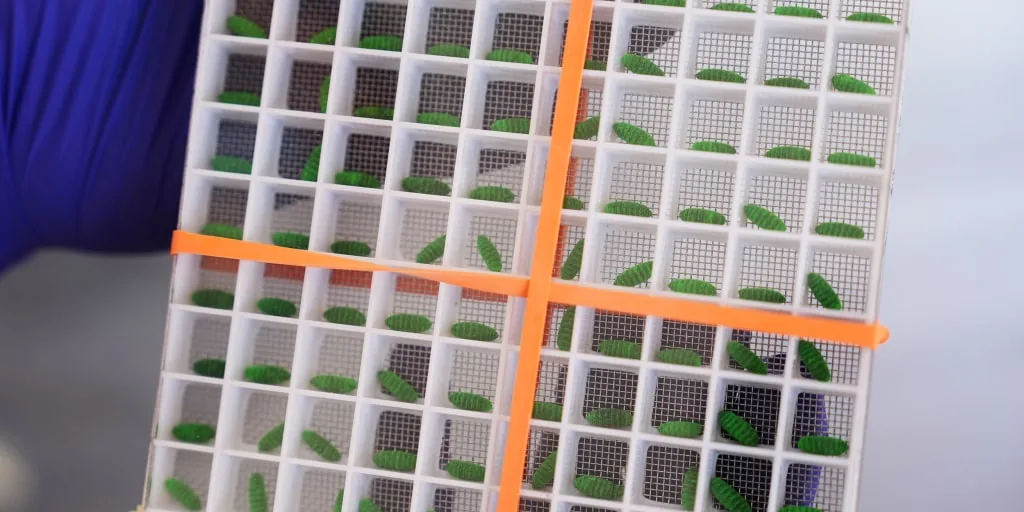
The screwworm is a species of blowfly attracted to rotting, unkept wounds; females can lay 200 to 300 eggs, which grow into larvae that look like wood screws and burrow into flesh, the article said. "The larvae that emerge from the eggs consume the flesh of warm-blooded animals," said Phillip Kaufman, a professor of entomology at Texas A&M University.
Screwworm larvae have mouth hooks that tear into an animal’s flesh and burrow deeper, creating open, rotting sores that can attract other flies; unless larvae are removed and an animal given larvicide and antibiotics, the infections are typically deadly. For humans, infections are extremely painful though uncommon, Kaufman said: "It’s eating your tissue, whether that be muscle or fat or skin."
Beginning in the late 1950s the U.S. built factories and dispersal sites in Florida, Texas and Central America that produced and released hundreds of millions of sterile flies each week; those sterile flies were irradiated and released en masse so wild females could not find viable mates, the article said, and cases in the U.S. reached zero in 1982.
The campaign continued in Mexico and other Central American countries and "took us until about 2004 to eradicate it all the way down past the Panama Canal," Kaufman said. In later years the northern plants closed as new plants opened further south, leaving only a plant in Panama that is "showing its age," the article said.
An outbreak that began in 2023 spread north to Panama and Costa Rica, then to Mexico and now to the U.S.; Kaufman asked, "Why did it get out? No one really knows."
The USDA is spending $750 million to build a facility in Texas that will produce about 300 million sterile screwworms each week, roughly three times current capacity; the facility will not be operational until late 2027 at the earliest and will take longer to reach full volume, the department said. Until that facility is online the article said the risk of a widespread outbreak will be high, and USDA estimates from 2024 show a widespread outbreak could cost the Texas economy about $1.8 billion a year because of livestock deaths, veterinary services, treatments and extra labor.
A group of bioethicists, conservation biologists and scientists met in 2024 to consider whether gene modification could be used to spread lethal genes through screwworm populations and published their perspective in Science; Kaebnick said the researchers "came to the conclusion there could be cases where it would make sense" but that the gene modification technology is untested at scale. "Those things aren’t ready for release just yet," he said.