
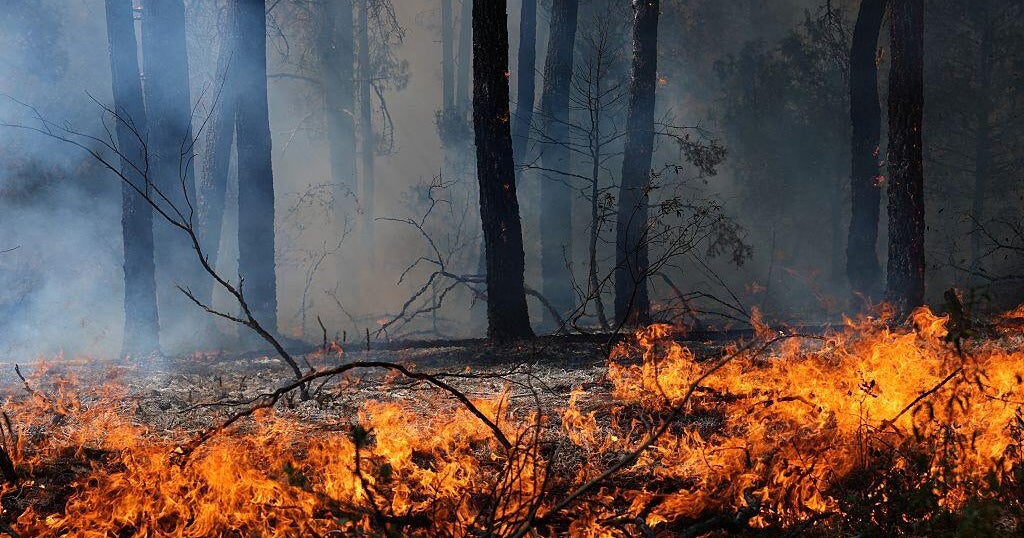
More than 300,000 people were forced to flee parts of Spain and France as wildfires continued to rage across Western Europe.
Thick black ash coated roof terraces in the north of Madrid's center, and authorities said people were being forced to keep their windows closed by the smell of throat‑irritating smoke. Spain's Interior Ministry reported that about 60,000 people had been evacuated in Ávila and areas near Madrid, including about 29,000 evacuated from the Madrid area and more than 20,000 people confined; in Ávila province more than 30,000 were evacuated and at least 8,000 were confined.
Spanish Prime Minister Pedro Sánchez, visiting the fire zone near Madrid, said the priority was to "save lives," warned that a "complex" fight lay ahead and said his government had declared a national emergency. Interior Minister Fernando Grande‑Marlaska declared a national state of emergency on Friday, authorities said. Sánchez said fires have burned 130,000 hectares of forest already this year in Spain, up from an annual average of 100,000 hectares over the past decade, and said more favorable weather on Saturday offered "a window of opportunity." He added, "We are going to have some complex hours ahead because although the temperatures have gone down, we do not know exactly how the wind will develop, how strong it will be."
Authorities in France's Gironde region issued overnight evacuation orders for five more localities as shifting winds and arid conditions complicated efforts to limit the blaze. The evacuation operation there now ranks among the biggest seen since World War II, with more than 250,000 people ordered out of the danger zone in one region alone, officials said. The area that has burned in the Gironde expanded to an estimated 162 square miles by Sunday morning, the prefecture said. Interior Minister Laurent Nuñez posted on X that "The situation remains very unfavorable," saying the fire "became extremely virulent again and unpredictable, generating its own winds and advancing erratically toward the Bordeaux metropolitan area" and that "it became calmer by the end of the night."
Firefighters are battling to slow the flames' progression toward Bordeaux both on the ground and in the air with planes dropping water and retardants, and soldiers have been called in to reinforce exhausted crews. French President Emmanuel Macron deployed 1,000 soldiers to help firefighters near Bordeaux and ordered an A400M military transport aircraft to join smaller planes. The head of the Paris fire brigade said about 100 firefighters from the capital were being sent to the southwest in addition to 45 firefighters and six vehicles already dispatched. Other European countries have sent water‑dropping planes helicopters and firefighters to assist.
Meanwhile in neighboring Spain, more villages in the fire zone west of Madrid were emptied overnight and a new front opened near the coastal city of Valencia. Juanfran Pérez Llorca, Valencia's regional president, told reporters late Saturday that "the fire is beyond our capacity to extinguish." Pilar Bernabe, the central government delegate to Valencia, wrote on X that "the night was very intense" and said "weather conditions are expected to deteriorate as the day progresses, so these hours are being used to battle the flames." In total, uncontrolled blazes in Spain this week have forced 116,000 people out of their homes.
A wildfire in a bushy ravine in Manises, a suburb of Valencia, raged out of control for four hours and killed one man on Saturday, local authorities said, marking Spain's first recorded death in the latest fires.
Evacuees described fear and frustration. Jacqueline Villafranca, 38, who evacuated to Madrid with her husband and two daughters, said, "I thought everything was going to burn, the house and everything." She added, "Here you can breathe normally — yesterday it was unbearable," while sitting in a gymnasium‑turned‑shelter. Audiovisual technician Luis said, "I cried at first because it's where I grew up. But now, it's more a feeling of anger and resignation, because there's nothing we can do as long as we're not allowed to go back and see what we'll find there."
Prime Minister Sébastien Lecornu described the fires as unprecedented and warned that changing weather had "profoundly altered the fire's dynamics." He said the coming hours could be difficult and that evacuation orders "must be respected without delay." Dozens of French firefighters have been injured, and emergency shelters were set up in schools and gymnasiums in southwestern France for tourists and residents.
Organizers of the Tour de France said they would shorten Sunday's final stage because security and police resources were reassigned to assist with the fires.
Spain and France requested and received international assistance. Italy deployed two Canadair water‑dumping planes to Spain and Spain's Civil Protection Service said it expected two more planes from Greece to arrive Saturday to join aircraft from the Netherlands and Portugal already operating there. France said it expected two water‑bombers from Croatia two planes from Portugal and two heavy‑lift Black Hawk helicopters from the Czech Republic and Slovakia. Satellite data from the European Forest Fire Information System showed the total area burned so far this year across EU countries is the second largest on record.
Fires advanced quickly because of tinderbox conditions worsened by successive heat waves since May, and scientists said global warming is increasing droughts and causing weather emergencies to become more extreme and more frequent, with Europe the fastest‑warming continent due to climate change. French health officials said earlier this week that at least 5,700 more people than usual died in France last month during a historic heat wave.
Thousands of emergency workers battled blazes in Italy's Sicily and Calabria regions, where a local official said arsonists had started some fires by tying rags soaked in flammable liquid to the tails of stray cats to spread the flames.