
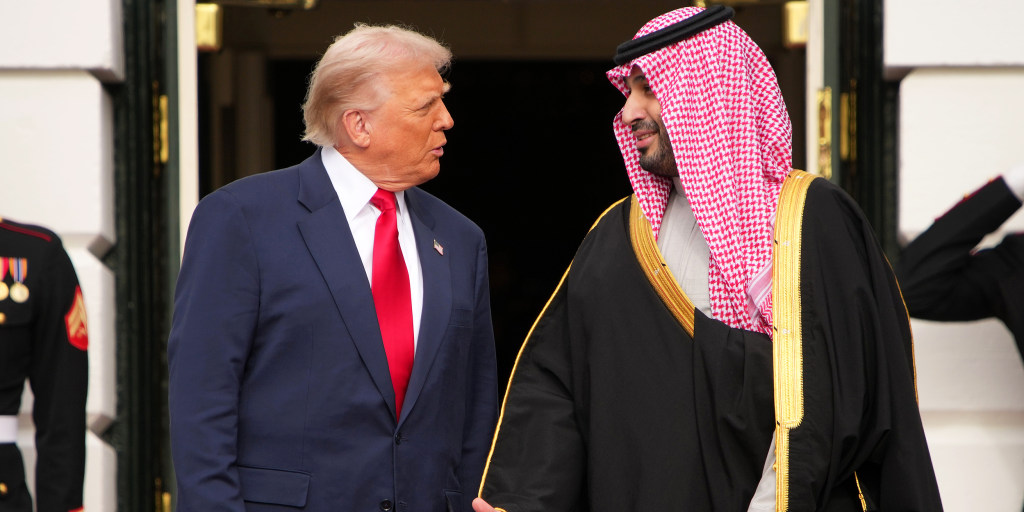
President Donald Trump approved a landmark civilian nuclear deal between the United States and Saudi Arabia that is expected to be announced Wednesday.
A senior administration official said the agreement would see the U.S. support creation of a Saudi nuclear power program and have American companies build and help run the program on Saudi soil for civilian purposes.
A regional official said the commercial deal is expected to be signed Wednesday at about 1:30 p.m. and would have U.S. companies running, not giving, Saudi government nuclear power for uses such as supporting AI data centers and enabling oil sales; the corporations involved have not yet been disclosed.
Two U.S. officials said the agreement leaves open the possibility that Saudi Arabia could enrich uranium domestically in the future and may allow the Saudis to enrich their own fuel for nuclear reactors.
The officials said the pact includes safeguards to inhibit weaponization but that the framework would be governed by the United States and Saudi Arabia rather than the International Atomic Energy Agency; the officials also said the agreement spans 30 years and is valued at tens of billions of dollars.
Secretary of State Marco Rubio said, "Suffice it to say, the U.S. is not going to reach any agreement with any country in the world that leads to the risk of proliferation."
Experts raised proliferation concerns: Darya Dolzikova said, "Any country, period, but particularly countries of proliferation concern have to be really, really robust on their nonproliferation provisions," and Sanam Vakil said, "If Saudi Arabia does retain the right to enrich, it’s the issue of domestic enrichment that will be more concerning and alarming."
The reports said the administration is expected to submit the deal to Congress as required by federal law, that Congress would be required to vote on the agreement and that lawmakers would need a veto-proof majority to block it.
The Wall Street Journal first reported the agreement, and the reports said it follows prior U.S. discussions including Energy Secretary Chris Wright's talks with Saudi energy officials and a Nov. 2025 joint declaration in which Wright said, "Today is a historic day for the United States and the Kingdom of Saudi Arabia."
The reports placed the pact in a broader regional context, saying the civilian deal is likely to irritate Iran, that the United States and Israel launched a war against Iran in late February that continues, that Saudi Arabia signed a mutual defense pact with Pakistan whose defense minister said Pakistan’s nuclear program would "be made available" to Saudi Arabia if required, and that Gulf tensions have included a rift between Saudi Arabia and the United Arab Emirates.