
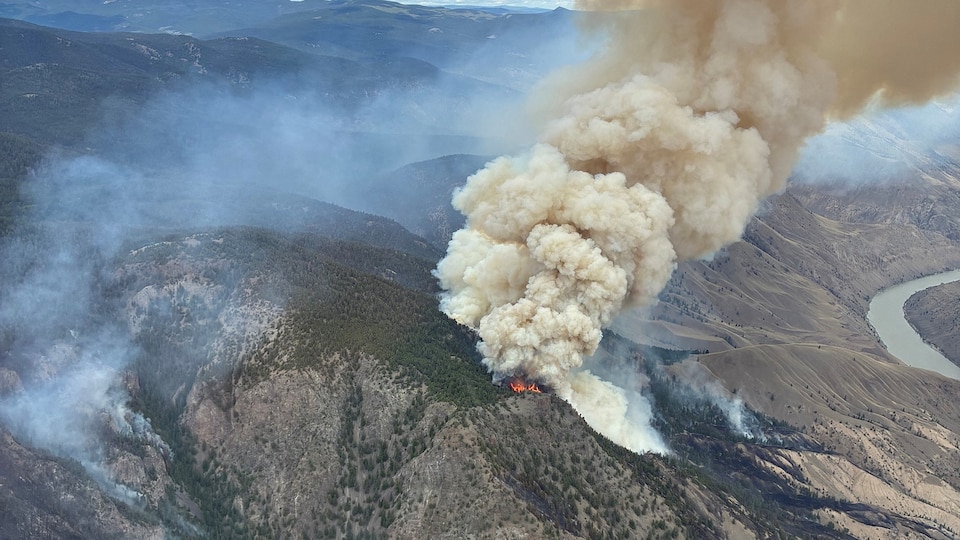
Canada has nearly 900 wildfires burning, and winds are directing heavy smoke into the upper Midwest and Northeast, creating dangerous air quality for millions.
Along the northern edge of Minnesota there are 17 fires still burning and an emergency declaration is in place to help mobilize suppression efforts, and more than a dozen wildfires in northern Minnesota near the border are growing with little or no containment and forcing mandatory evacuations.
Some of the largest blazes are burning north of Lake Superior and in west-central Ontario through thick forests in remote parts of the province, and officials said many of those fires are within or close to national parks and First Nation communities, releasing an incredible amount of smoke.
Very heavy smoke is over Duluth, Minnesota, and Marquette, Michigan, and extreme smoke is over northern Wisconsin.
Air quality alerts have been issued in more than 20 states, including parts of North Carolina, Minnesota, Vermont, Connecticut, New York, Massachusetts, Rhode Island, New Jersey, New Hampshire, Pennsylvania, Illinois, Indiana, Ohio, Delaware, West Virginia, Colorado, Virginia, Maryland, Washington, D.C., Michigan and Wisconsin.
Detroit and Minneapolis rank among the top major cities for poor air quality, and Detroit reached an air quality index around 600 on Thursday morning; the most dangerous level, "hazardous," begins at an AQI of 300.
Detroit was listed as having the worst air quality in the world on Thursday on IQAir's global rankings, followed by Toronto, with Minneapolis and Chicago also among the most polluted major cities, officials said.
All of New York state, including New York City, and parts of New Jersey are under an Air Quality Advisory because of smoke from more than 100 wildfires burning in Canada, and the New York State departments of Environmental Conservation and Health issued a statewide Air Quality Health Advisory for Thursday.
The city of New York has expanded its response, extending the heat emergency plan, keeping hundreds of cooling centers open and intensifying Code Red outreach to connect unsheltered New Yorkers with air-conditioned spaces, Mayor Zohran Mamdani said.
The city is distributing free KN95 masks at more than 200 public library branches, at all NYPD precincts, nine FDNY firehouses and four major transit hubs and through partnerships with several city agencies and local council members, and state officials said more than 100,000 N95-style masks were being made available to counties with additional masks to be distributed to commuters at Penn Station and Grand Central.
Minnesota officials issued an air quality alert from Tuesday through Friday for areas including the Twin Cities metro area, and very heavy smoke was expected across the state's northeastern corner with air quality levels reaching hazardous in parts of northeast Minnesota.
Forecasts show the smoke will continue to move east through the Northeast and push farther south, with forecasters warning additional waves of smoke could push into Virginia through Friday and the most intense smoke possibly reaching Washington, D.C., by midday Thursday, and those areas are now expected to experience smoke-filled skies at least through the weekend.
Satellite images show wind carrying smoke primarily southeast from Ontario across to Toronto and New York state and reaching Boston, and meteorologists said a second smoke plume was forecast to hit New York and Boston later on Thursday with wind patterns suggesting exposure will ramp up down to Virginia and parts of North Carolina through Friday; a change in wind direction by Monday is expected to bring some relief.
A dramatic video from Ontario showed a freight train surrounded by wildfire flames and the crew requesting emergency assistance; Canadian National Railway said the workers who were trapped outside Armstrong were all safely rescued and operations have been temporarily suspended in the region.
Grand Council Chief Linda Debassige said the remote Namaygoosisagagun First Nation in northern Ontario was "devastated by an unexpected and fast-moving wildfire" that severely damaged homes and community buildings; officials said six communities are under evacuation orders with reports of damage to properties.
Thousands of people in the region have been forced to evacuate northern Ontario areas.
The Canadian Wildland Fire Information System and other officials said the vast majority of the wildfires are burning out of control, and the Canadian Interagency Forest Fire Centre reported 23 new fires on Thursday.
U.S. and Canadian fire agencies said the recent outbreaks were likely fueled by sustained hot weather at the end of June and below-average rainfall in northern Ontario, and meteorologists described a heat dome trapping warm air and smoke and creating drier vegetation that can act as fuel while unstable hot air and storms can produce strong winds that spread fires and smoke. Officials said significant fire spread occurred on July 13, and record-breaking temperatures created a heat dome across western Ontario and Minnesota with some places reaching over 100 degrees. "You have a firehose of smoke coming right now," Derek Mallia, a professor of atmospheric sciences at the University of Utah, said.
Health officials warned that wildfire smoke contains very small particles such as PM2.5 and nitrogen dioxide that can get deep into the lungs and cause inflammation, and Jim McDonald, New York State Department of Health commissioner, said those particles "get all the way down into our lungs, all the way down to our tiny breathing tubes and… they cause inflammation."
Researchers and public health experts warned the pollution from wildfires is linked to heart attacks, heart failure, stroke and respiratory illness and that chronic exposure raises risks in pregnancy and child development. David Eisenman, a professor of medicine at the David Geffen School of Medicine at UCLA, recommended following Environmental Protection Agency guidance such as staying up to date on air quality reports, using air purifiers and replacement filters, setting up a "cleaner air room" and wearing an N95 mask if people must go outside.
Long-term outlooks show wildfire risk is expected to remain above normal in the Canadian Northwest Territories, Ontario and Quebec throughout July and August, and officials noted recent very large seasons, saying the 2023 fires razed 15 million hectares while 2025 blazes burned 8.3 million hectares.
An Air Quality Alert remains in effect for the Chicago area Friday because of smoke from Canadian wildfires, and AccuWeather meteorologist Tracy Butler said the worst of the air quality will be in the morning and could improve in the afternoon. Butler warned that afternoon and evening rain and storms could mix with smoke to leave behind a sludge, and she said air quality should be better on Saturday though smoky skies could return on Sunday. The smoke and haze have caused low visibility and could delay flights at O'Hare Airport. Several major events were rescheduled, including a Millennium Park summer music series performance and the Chicago Fire match at Soldier Field, and the Chicago Park District closed all beaches and outdoor pools and moved all-day camps indoors. Health experts said the air is unhealthy for everyone and urged people to avoid or limit time outdoors; Dr. Juanita Mora of the American Lung Association said, "If you can see it, and you can smell it, you're breathing it in...so recommendations right now: if you don't have to go out, then stay home," and doctors encouraged people to stay hydrated to help the respiratory system.
A Climate Central report found that per-person exposure to harmful wildfire smoke in the U.S. averaged four times higher during 2020-2024 each year than during 2006-2019, underscoring research that human-caused climate change is making wildfires more likely and more intense.
The National Weather Service issued an air-quality alert after smoke from the Canadian wildfires drifted south to New York City and even beyond out into the Atlantic, and Mayor Zohran Mamdani urged residents to stay inside. "Every New Yorker should take precautions. Limit your time outdoors, especially strenuous activity," Mamdani said. The city's office of emergency management encouraged people to avoid being outside for more than an hour and posted on X, "Listen to your body. If you have watery eyes, a scratchy throat, or difficulty breathing, reduce physical activity and go indoors."
The smoky air was compounded by soaring temperatures in the city, where the heat reached above 90F, and residents reported symptoms such as stinging eyes; Rachel Smalter Hall, a publisher in downtown Manhattan who has asthma, said, "I had noticed when I was outside that my eyes were stinging," and she and her daughter limited outings and postponed some in-person appointments because of the hazardous air.
Philadelphia issued a "Code Purple Air Quality Emergency Day" on Friday and warned, "Everyone may experience negative health effects from particulate matter in the air," adding that members of sensitive groups may experience more serious health effects.
More than 100 of the fires in Canada have been categorized as out of control, and almost 200 of the blazes are in Ontario.
Heavy rain moving over the Minnesota-Canada border Friday morning should help some fires, but the storms could also bring strong winds and lightning that can spark new fires; passing showers and thunderstorms are possible in Ontario Friday, though that rain is not expected to be enough to put the wildfires out, and there are more chances for rain over Ontario Sunday through Tuesday.
By Friday afternoon the worst air quality was expected from Detroit to Cleveland to Pittsburgh to Washington, D.C.; forecasts called for a brief reprieve in Detroit and Chicago on Saturday morning while heavy smoke continued from Buffalo to Boston to Washington, D.C., and returned to the Great Lakes by Saturday evening.
Michigan saw a statewide air quality advisory on Wednesday.
On Friday morning the air quality index in Detroit was 435, one of the worst readings among major cities.
Smoke from the fires has been setting records in Wisconsin and turning skies orange in Vermont.
May-Lin Wilgus, a pulmonologist and professor at UCLA, compared breathing wildfire smoke to smoking a lot of cigarettes, saying the exposure on smoky days can be similar to smoking a quarter to half a pack a day.
Smoke was expected to be probable over New York City on Sunday during the FIFA World Cup Final at MetLife Stadium in New Jersey, and officials said authorities were monitoring the situation.
President Donald Trump on Friday vowed to confront Canada over the wildfires, calling the situation "totally unacceptable" and writing on Truth Social that "the costs inflicted on the U.S. must of necessity be added to the TARIFFS Canada is currently paying." He said he planned to call Canadian Prime Minister Mark Carney later Friday "to find out what they are going to do about it."
Ontario Premier Doug Ford told U.S. lawmakers, "Maybe what you should do rather than complain is send support."
White House officials, including Andrew Giuliani, the head of the White House's World Cup task force, were holding informal meetings with FIFA officials and others about concerns for Sunday's World Cup final, and no larger formal meeting had been planned.
Press Secretary Karoline Leavitt told press yesterday that Trump was expected to attend a FIFA reception later Friday and would attend the game on Sunday.
The British Columbia Wildfire Service said there were 59 active fires in British Columbia, 39 of which started in the prior 24 hours, and that 31 were out of control.
Matthew Hoppe, incident commander for the Namaygoosisagagun First Nation, said the community "self-evacuated" via small boats on Monday as the fire approached, that there were no deaths or direct injuries, and that residents were "distraught" and speaking with government to "firm up resources" as they plan to rebuild.