
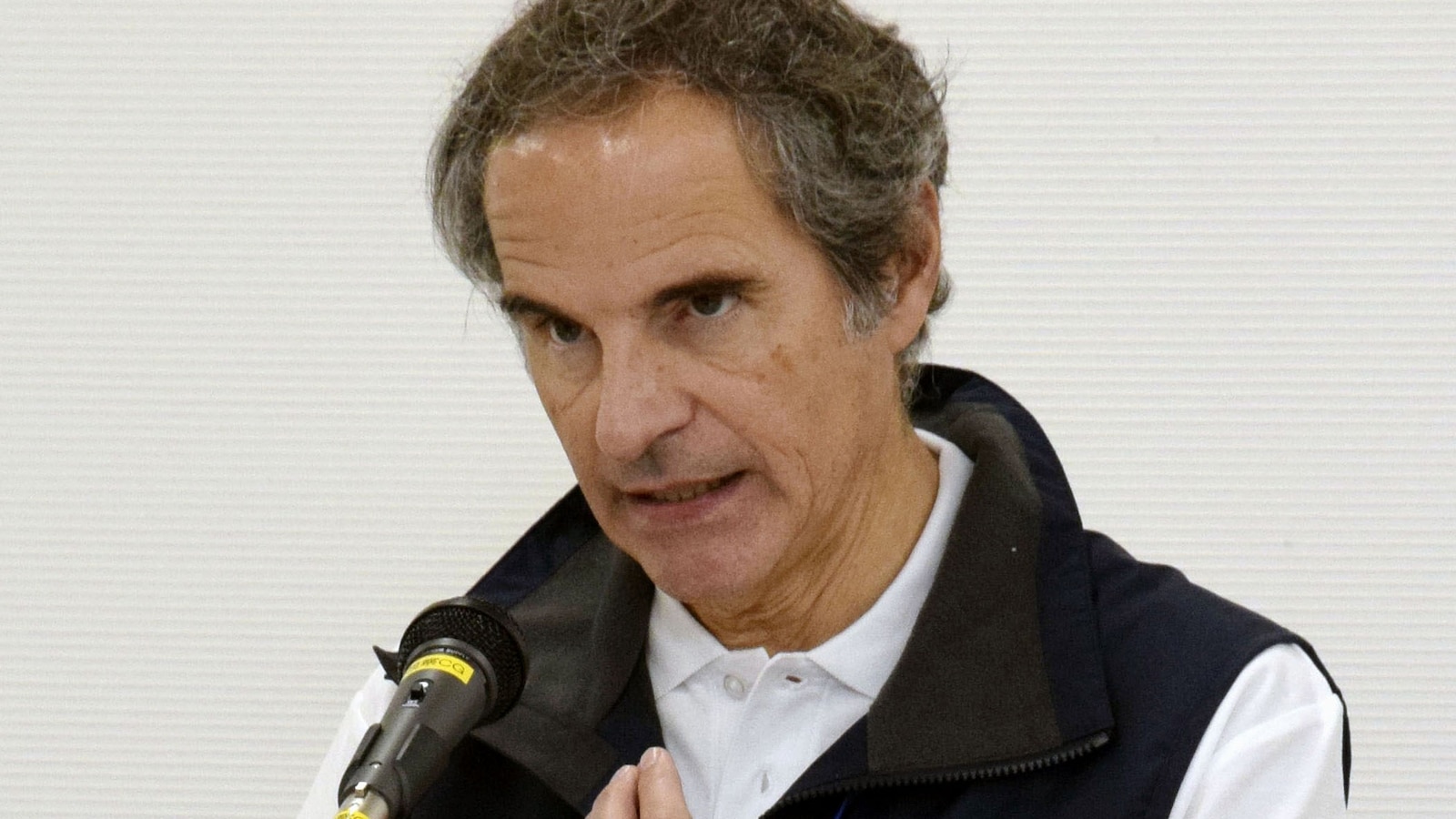
IAEA chief Rafael Mariano Grossi said Wednesday that inspectors will visit Iran's nuclear enrichment sites, a key part of an interim deal between the United States and Iran.
Grossi told journalists at the tsunami-hit Fukushima Daiichi nuclear power plant that "there has been a Memorandum of Understanding, signed by both presidents," and that the accord "says explicitly that the nuclear activities that are going to be carried out with the regards to the nuclear material facilities will be supervised by the IAEA — in all letters."
He acknowledged contradictory remarks from Tehran and Washington, calling it a "war of words" at the moment, and added: "Obviously, to do that, we will have to inspect. Whether this happens the day after tomorrow or in one week or in 10 days, it's important, but not essential. This is going to happen."
Since Israel launched a 12-day war on Iran in 2025, the IAEA has been blocked by Tehran from visiting enrichment sites where the Islamic Republic is believed to store enough highly enriched uranium to potentially build as many as 10 nuclear weapons, should it choose to rush for the bomb.
The U.S. and Iran agreed to a deal last week that calls for Tehran to dilute or downblend its stockpile of enriched uranium and waives U.S.-backed sanctions on Iranian oil; the inspections are key to carrying out the downblending called for by the agreement.
There was no immediate reaction from Iran. On Tuesday, Iran's Foreign Ministry spokesperson Esmail Baghaei told reporters in Tehran that U.N. inspectors were not scheduled to examine nuclear sites bombed by the U.S. last year, rejecting comments made a day before by U.S. Vice President JD Vance.
The IAEA has been allowed to visit other nuclear sites in Iran since the 12-day war in 2025, such as the Bushehr nuclear power plant, but without accessing enrichment sites the agency says it is unable to verify the status of Iran's stockpile or check the cascades of centrifuges used to enrich uranium; both Iran and the IAEA say Tehran hasn't been enriching uranium, but nonproliferation experts worry the Islamic Republic may be moving its stockpile to undeclared areas.
Pakistan's Foreign Ministry said Wednesday that technical-level talks between the U.S. and Iran are expected to resume early next week at the Bürgenstock resort in Switzerland.
Grossi's remarks came as U.S. Secretary of State Marco Rubio arrived in the Persian Gulf for a three-nation tour, beginning with a closed-door meeting and private working lunch in Abu Dhabi with Emirati President Mohamed bin Zayed Al Nahyan; Rubio was scheduled to travel next to Kuwait and then Bahrain.
President Trump and Iranian President Masoud Pezeshkian signed the agreement last week, launching a designated 60-day negotiating period during which Pakistani and other mediators hope to bring the two sides to a permanent settlement to end the war, and Iran's chief negotiator Mohammad Bagher Ghalibaf called the Islamabad understanding "a declaration of America's defeat."
The Senate on Tuesday approved a House-passed war powers resolution on Iran in a 50 to 48 vote, with four Republicans joining the bulk of Senate Democrats in support and one Democrat opposing; two Republicans did not vote. The resolution directs the president to "remove United States Armed Forces from hostilities against the Islamic Republic of Iran," unless Congress declares war or authorizes the use of military force, but it is a concurrent resolution that does not carry the force of law and does not require the president's signature.