
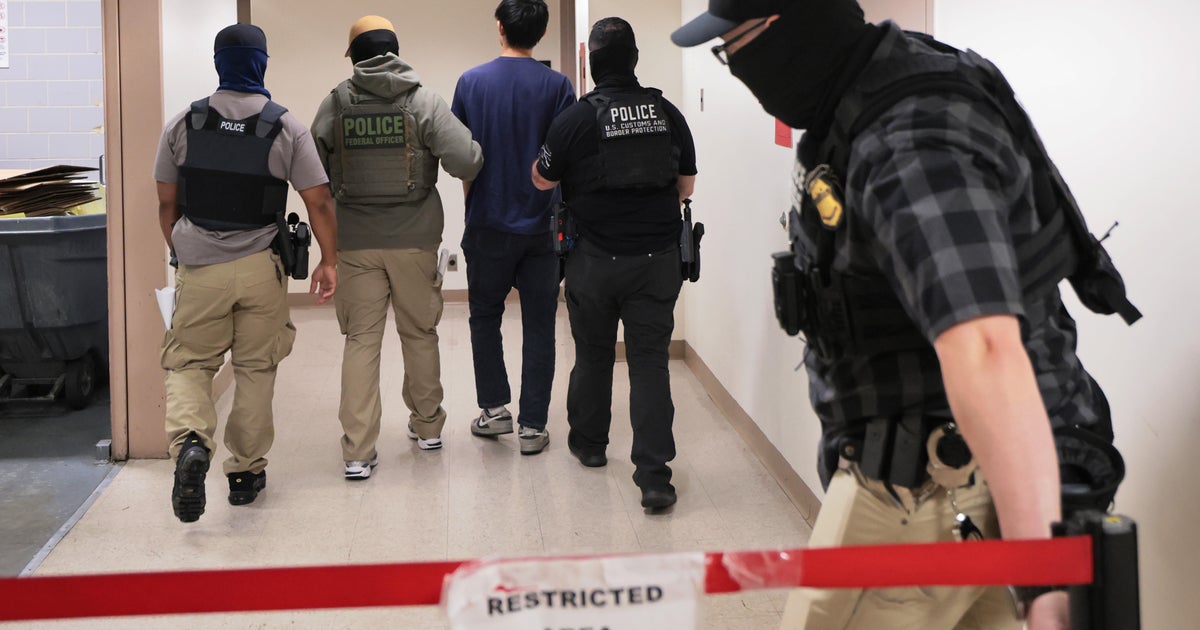
U.S. District Judge P. Casey Pitts in the Northern District of California issued a nationwide injunction Tuesday blocking multiple Trump administration policies, including arrests at immigration courts and elimination of a cap on detention time.
Pitts said in a 71-page opinion that the policies were arbitrary and violated the Administrative Procedure Act and said attorneys for Immigration and Customs Enforcement and the Executive Office for Immigration Review "failed to provide reasoned explanations for their actions."
The practice of making arrests at immigration courts began during the Trump administration and enabled federal law enforcement agents to take into custody individuals who were appearing before immigration judges, a tactic community leaders and Democratic lawmakers have railed against for producing dramatic confrontations in the hallways outside courtrooms and leaving communities "traumatized."
Pitts said, "ICE is not arresting individuals who appear for criminal or civil violations 'unrelated' to the arrest but instead arresting noncitizens based on the very immigration offenses for which the noncitizens are appearing in immigration court."
He said the policy was "based on a false premise" that ICE had properly rescinded past guidance on arrests at immigration courthouses and "fails to provide a rational explanation" for its removal of previous limits on civil enforcement actions at immigration courts.
Pitts said that the detention waiver, which allowed ICE to hold detainees for more than 12 hours, also violated the Fifth Amendment rights of detainees because they were subject to "punitive conditions of confinement."
He said ICE has held some detainees at an immigration center in San Francisco for more than 12 hours — and often overnight or for multiple days — and struck down the policy because ICE "failed to consider alternative options to address its capacity issues," which were at the root of the policy's implementation.
DHS general counsel James Percival wrote Tuesday night on X, "When a judge sentences a defendant, the defendant is taken into custody. If an alien is ordered removed by an immigration judge, the same should happen. A district judge ordering otherwise is naked judicial activism in service of an anti-American, open borders agenda."
Separately, a federal judge in New York ruled last month that federal agents can no longer make arrests at immigration courthouses in Manhattan, and U.S. District Judge P. Kevin Castel similarly found that the Trump administration's withdrawal of the prior limits on enforcement actions at immigration courts was "arbitrary and capricious."
Pitts said the reversal of long-standing policy against arrests at immigration court resulted "not from merely unreasoned decision-making but a complete lack of decision-making," and that authorities failed to address the "chilling effect" of arrests on whether people attend court hearings.
Pitts, who was appointed by President Joe Biden, wrote, "For 80 years, Congress has commanded federal agencies to think before they act," referring to the Administrative Procedure Act, and said the law "does not require an agency to make the choice that a reviewing court might deem preferable. But it demands that an agency at least provide sound reasons for following its chosen course." He also noted that after Trump took office, hearings across the country often ended with cases being dismissed by the government, setting the stage for plainclothes agents to make arrests in hallways in coordination with attorneys from the Department of Homeland Security.